
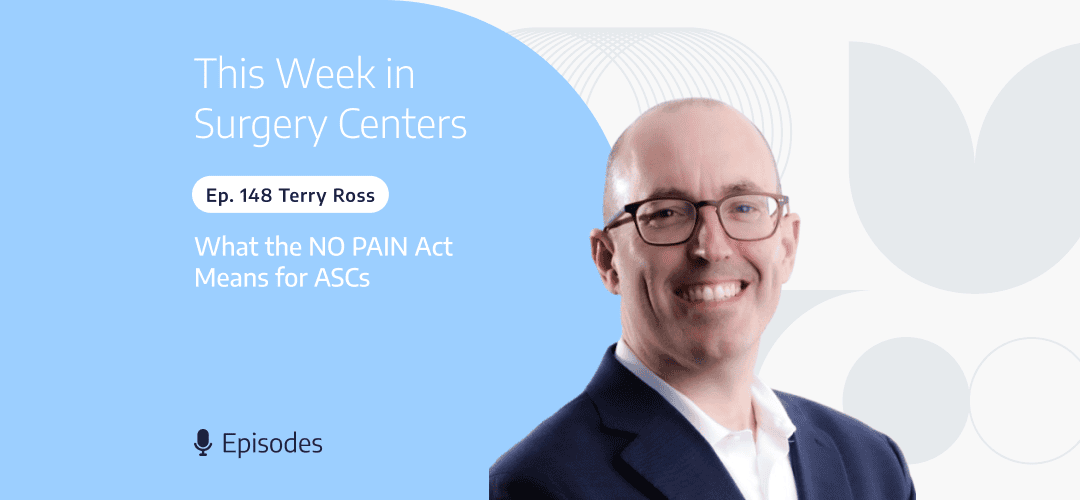
Here’s what to expect on this week’s episode. 🎙️
Terry Ross, Group President, Prevention & Recovery at Enovis, joins us to break down what the NO PAIN Act means for ASCs. He explains how the law creates a Medicare reimbursement pathway for qualifying opioid-sparing treatments and what centers should know about clinical evidence, implementation, and reimbursement.
In this week’s news recap, we cover new bipartisan legislation focused on Medicare ASC payments, what recent HCA and Tenet results reveal about case mix, and Anthem’s moderate-sedation reimbursement changes.
Resources Mentioned
Guest Discussion
- Enovis NOPAIN Act Resources
- CMS: Non-Opioid Treatments for Pain Relief
- Study: The Use of Cold Therapy Following Arthroscopic Rotator Cuff Repair
News Recap
- Outpatient Surgery Access Act of 2026
- Tenet Healthcare: Second Quarter 2026 Results
- HCA Healthcare: Second Quarter 2026 Earnings Call
- Anthem: Moderate Sedation Reimbursement Policy
Brought to you by HST Pathways.



Ep. 148 Terry Ross – What the NO PAIN Act Means for ASCs
Here’s what to expect on this week’s episode. 🎙️
Terry Ross, Group President, Prevention & Recovery at Enovis, joins us to break down what the NO PAIN Act means for ASCs. He explains how the law creates a Medicare reimbursement pathway for qualifying opioid-sparing treatments and what centers should know about clinical evidence, implementation, and reimbursement.
In this week’s news recap, we cover new bipartisan legislation focused on Medicare ASC payments, what recent HCA and Tenet results reveal about case mix, and Anthem’s moderate-sedation reimbursement changes.
Resources Mentioned
Guest Discussion
- Enovis NOPAIN Act Resources
- CMS: Non-Opioid Treatments for Pain Relief
- Study: The Use of Cold Therapy Following Arthroscopic Rotator Cuff Repair
News Recap
- Outpatient Surgery Access Act of 2026
- Tenet Healthcare: Second Quarter 2026 Results
- HCA Healthcare: Second Quarter 2026 Earnings Call
- Anthem: Moderate Sedation Reimbursement Policy
Brought to you by HST Pathways.
Episode Transcript
[00:00:21] Ryan Cohn: Hi, everyone. Here’s what you can expect on today’s episode. This week we’re continuing our “Trust the Data” series with Terry Ross, who leads the prevention and recovery businesses at Enovis.
Terry joins us to explain how the NO PAIN Act is creating a Medicare reimbursement pathway for qualifying opioid-sparing treatments in surgery centers and hospital outpatient departments. Terry also shares practical guidance on implementation, reimbursement, and how centers can evaluate the evidence behind these treatments. After the conversation, we’ll cover new bipartisan legislation focused on Medicare ASC payments, what recent financial results from HCA and Tenet reveal about case mix, and a commercial payor reimbursement change affecting moderate sedation billing.
I hope everyone enjoys the episode, and here’s what’s going on this week in surgery centers.
[00:01:18] Ryan Cohn: All right, Terry, so excited to have you here. Can you share a little bit about your background and how your work intersects with outpatient surgical recovery?
[00:01:26] Terry Ross: Sure. Thanks, Ryan. I appreciate being on and getting to talk with you about IceMan and the NO PAIN Act. I lead the prevention and recovery businesses at Enovis. So this is about half the company, and you can think of it as all of our medical devices that are externally applied to the body.
So these are things like DonJoy knee braces, Aircast walking boots Chattanooga rehabilitation equipment, laser therapy, shockwave electrical stimulation, other things that you’d use in the athletic training room or the physical therapist’s office. Bone growth stimulators for patients that have trouble healing from non-union and some, you know, variety of other items and therapies around the world.
So we touch patients at every stage of their musculoskeletal journey. Everything from, protection and training recovery for performance athletes to all of the accidents and sort of, daily living incidents of sprained ankles and broken bones and other things that we have through life and all the chronic diseases like knee osteoarthritis and lower back pain and the challenges that typically come with with aging and everything in between.
And obviously a key part of that is be- both prehab and, rehab around surgical episodes when, other forms of rehabilitation aren’t enough to help the patient and they need surgical intervention.
[00:02:48] Ryan Cohn: Awesome. Yeah, and I’ve been really excited to speak with you and learn a little bit more about what you guys do and and learn a little bit more about the NO PAIN Act and what changed under the NO PAIN Act, and what does that mean for outpatient surgery?
[00:03:00] Terry Ross: Yeah. So the NO PAIN Act is a bipartisan law that really expands Medicare’s coverage of opioid-sparing devices. And the, the law came in a few years ago, obviously led by a couple of senators from states that were particularly impacted by opioid dependency deaths.
And the the benefit for the system is there are a lot of products like ours that exist in the marketplace but had reimbursement challenges, right? To be honest, economic challenges in the way of getting those devices to, to Medicare patients, right? For the benefit. And so the, the– what the NO PAIN Act really accomplished is because of its clinical rigor, right?
Making sure these are devices that specifically create reduced opioid use post post-surgery and value around making sure that sort of the single variable analysis that these really do have the cause and effect that they were after with the reimbursement pathway that, gets created to help outpatient centers, which is the focus of the NO PAIN Act bring, get help get those devices to patients without some of the barriers that were in the way before.
These are typically devices when you look at the list that, that have been approved that existed in the marketplace, but the use of them often had hurdles.
It creates a reimbursement pathway. So take the, IceMan which is our product and it’s true for many of the others on the list as well. In the past, there wasn’t reimbursement either to, s- so, for this therapy in the, in these applications. And so the so the– they sometimes would be provided.
Occasionally, a clinic would believe in it so strongly that they would just absorb the cost in their sort of cost of supplies. But obviously, that’s an economic burden. The others would do cash pay for the for the patients to, ’cause they still again, believe that in the benefit of the product.
But then, that doesn’t have equity, right, for everybody in the healthcare system when it’s just a cash pay available device.
And so the NO PAIN Act creates a reimbursement mechanism which allows the facilities to have an economically viable, sustainable way of incorporating these devices into their standard of care protocols.
And the so this is got an economic benefit to the outpatient center the ASC or a qualifying HOPD. And obviously the patient gets the the benefit which translates in a couple of ways. It’s lower pain their, their experience through their recovery, which means they’re moving more.
They tend to be more compliant with the instructions they’re given post-surgical when the, when you have lower pain. Their patient satisfaction is higher with the overall, procedure, and their use of opioids in the short term post-operative is significantly lower, but also in the long term.
And the there’s a lot of real world evidence that’s been able to show that patients that use motorized cold as part of their recovery have lower long-term measured at 180 or 365 days opioid use. And that is what really creates the savings for the system.
[00:06:23] Ryan Cohn: Yeah
[00:06:24] Terry Ross: the patient wins, the outpatient facility wins, and Medicare wins because the the cost of treating long-term opioid dependency versus the upfront cost of product like IceMan.
So for us, we calculate that benefit over time statistically is about a three to one benefit to the healthcare system.
[00:06:48] Ryan Cohn: Wow
[00:06:49] Terry Ross: So it’s a triple play, right? It’s a win-win-win for, everybody sort of involved in the in the system. And we’re really appreciative that the NO PAIN Act, creates this pathway,
For for the benefit of really all of us in that that, that care about and work to provide the best we can for the patients.
[00:07:09] Ryan Cohn: Yeah, it’s such important work that you guys are doing, and I’m so glad that this is coming to the forefront and opioid-sparing care is becoming more and more important. And when did the NO PAIN Act come out? Is this relatively recently?
[00:07:23] Terry Ross: Let’s see. I don’t remember the exact dates. I want to say it came out in 20– it was it was in the early 2020s. It actually took a few years, typical of legislation, right? To come into effect. And then it took us a couple of years, even though we believed right up front that that IceMan was a that this was a tailored fit, right?
A perfect fit for the NO PAIN Act.
[00:07:46] Ryan Cohn: Yeah
[00:07:47] Terry Ross: took us two years of, pursuing CMS, presenting clinical evidence, adding clinical evidence, right? To eventually meet their threshold and get approved and be able to start rolling this out to to our customers, right? To the outpatient center. So we began we received approval and a device-specific code for the reimbursement last fall with the ability to, for, for facilities to start billing Medicare at the beginning of 2026.
[00:08:21] Ryan Cohn: Interesting. So yeah, it takes time to, to get the ball rolling, but it sounds like you guys are well underway now. And so how should prov- providers think about opioid sparing care as part of a broader recovery strategy at their center?
[00:08:36] Terry Ross: So multimodal pain management, is the standard of care, and this creates another modality, another layer, right, that physicians can layer into their treatment protocol. So the– and each of these plays at a different, sort of, mechanism. So ice and the IceMan addresses the inflammatory and swelling components, right, of postoperative care.
That’s really where the benefit is. Ice is well understood by healthcare professionals, right? That it has this benefit. And what IceMan does as a unit is packages it in a way that it’s, very convenient and very long-lasting for the patient. And so the advantage of motorized cold, everybody, is familiar with the bag of peas, right?
Or a, a, a simple cold pack. You get 15, 20 minutes of cold relief out of that unit or out of that u- the single-use pack, and it’s got the downside of you’re exposed directly to freezing temperature. And so to even try and use it longer or continuously if you can keep it cold, you have risk of frostbite especially for elder patients or if you fall asleep or if you’ve got other comorbidities that make it harder for you to sense the, the, the the cold when you package it in IceMan, you now get up to eight hours of cold relief.
And because of the way it recirculates the the, the, the water coming back in, you’re not at freezing temperature. so it maintains you at a safe temperature range, so you can go to sleep with this unit, right, effectively and not have the risk of frostbite from continuous cold, and get the benefit of and comfort of long-term use without needing you or a caregiver to constantly be up, switching out packs, reapplying and doing things.
So the result is people use the cold therapy more consistently, longer duration, and more safely. And therefore they get a beg- better pain relief benefit from it. And that pain relief benefit translates not only into, in the studies, about a 30% reduction in short-term opioid use over those first several days post-surgery, but a notable reduction in the percentage of of patients that remain on opioids a year out from from surgery.
And that’s really where the system benefit comes in, is avoiding that long-term use. The patient gets lower pain scores and less opioid use, immediately the first couple of days post-surgery. And then the system benefits is really what accrues over time.
[00:11:18] Ryan Cohn: Interesting. Very interesting. It’s this is– I’m learning so much on this call. So
[00:11:23] Terry Ross: it’s funny, a lot of the devices we do, you think about, IceMan, bracing and supports, these, these concepts, right, are– have been out there for a long time. The art is all in, in the innovation, right, that we strive to bring as a company, right? It’s all in, in figuring out how to make these things really usable
[00:11:42] Ryan Cohn: Mm-hmm.
[00:11:43] Terry Ross: How do you make it comfortable? How do you fit it into daily life? And importantly, the workflow in the clinic, which I think we’ll talk about here in a bit, but that’s an important part of the element as well and how we think about bringing our solutions, right, and getting them to patients, is it has to integrate seamlessly into the workflow in the physician clinic or the surgical center.
[00:12:08] Ryan Cohn: Yeah. Yeah, absolutely. And so, because this series is all about trusting the data, I want to ask you, when it– when evaluating an opioid sparing treatment, what sort of evidence or data should a center or should leaders look for?
[00:12:26] Terry Ross: Yeah. Well, one is the NO PAIN Act. One of the, the positives about the way it was constructed is it did set a very high standard for clinical evidence. So we had to demonstrate meaningful reduction in opioid use. We had to demonstrate single variable cause to to qualify. So one of the first things that, that leaders can do is go look at the list of qualifying devices under the NO PAIN Act and recognize that the, the act itself and the CMS’s administration of that has established a high degree of rigor.
And so the so that’s one. The second thing you can do is you can go visit enovis.com on, on, on IceMan is one of those devices, and search under the NO PAIN Act or under the term IceMan, and you can click through to the clinical studies. The most recent one and one of the most comprehensive is one by Dr. Sarah Edwards. She’s out at UC San Francisco. And so she did analysis that was published last year for use of IceMan motorized cold as an adjunct to standard protocols for rotator cuff surgeries. And that was the sort of the final piece that got us over the hurdle and the approval from from CMS to to qualify to qualify the the device.
[00:13:45] Ryan Cohn: Got it.
[00:13:46] Terry Ross: And importantly, we became the first device qualified under NO PAIN Act that was not pharmal- pharmacological in some way, right? The other devices are pain pumps or nerve blocks or other pharma related devices where we are, we don’t add to the, to the polypharmal pharmacy mix, right?
Of treating the patient and worried about interactions with other medications. Ours the, the IceMan is able to sort of layer on top of whatever other pain approaches the physician is choosing to provide for the patient.
[00:14:26] Ryan Cohn: And so you mentioned the rotator cuff surgery I believe it was. What other types of procedures or which types of patients might benefit most from this type of recovery approach?
[00:14:37] Terry Ross: Yeah. So, so obviously we start from an orthopedic point of view because Enovis is a, an orthopedic medical device company. But the beauty of the NO PAIN Act is it actually is open to all types of surgeries done in the ASC or qualifying HOPD environment that the physicians believe this level of pain reduction is gonna have the opioid-sparing benefit. So if you look at the top surgical procedures, right, that tie to prevalence of opioid prescriptions, obviously a lot of that on the top of the leaderboard is orthopedic procedures like rotator cuff repair. But there are many others. And so this can get used once the, this gets put into the workflows in an ASC or HOPD, it is not limited to specific orthopedic procedures or to even to orthopedics.
It can be used broadly as part of the pain management protocols put in place by the physicians as long as the physicians believe it is medically beneficial, to the patient.
[00:15:48] Ryan Cohn: Got it. Interesting. And so what do you think a center should understand about its current recovery experience and process before potentially changing its protocol?
[00:15:59] Terry Ross: Well, as I mentioned, the, the fact that this can layer on top of existing protocols hopefully makes this easy for for folks as we think about, sort of integrating workflow because they don’t need to worry about conflicts with other pain therapy approaches, driven by the physician or the anesthesiologist.
But it does take implementation work. So, our first advice is this needs to be, built into the standard work protocols established for the surgical procedures or for the physician depending how that’s managed at the facility. So the, our first advice as we work with folks to implement is, to do that so it becomes systematic.
It becomes an automatic part of the protocol, just like, a lot of the other approach they have to, the, this type of procedure or for this physician.
The second is to work through the billing practices. So the way this gets billed, it’s not like other DME. It actually, it’s got a C code the, I think, I forget the, the, the 9810, I believe C9810 is the one for IceMan.
But the– and so we would come in and just work with the administrator to the, to, on how to submit the code and make sure that the coding is proper to, receive reimbursement through the through the NO PAIN Act. And th- so it’s put through as a proced- or excuse me, as a facility code and gets the facility markup that’s unique for each facility, but readily available to the chargemaster, right, at each at each facility to be able to implement.
So the implementation is pretty simple, but it does take, a sort of specific action to build this into protocols and make sure that your billing is accurate so that, you’re gonna get reimbursed appropriately, right out of the gate and not create distraction for the administration team.
[00:18:01] Ryan Cohn: Interesting. And are there any other, with the centers that you’ve worked with, are there any other, I guess, tips and tricks or things that you would recommend to ensure that it is a successful implementation?
[00:18:15] Terry Ross: Yeah. So the first thing is use us. That’s part of what we’re there for. So, the the, the the, the because we’ve, worked with other facilities now and, both our team, right, is ready to answer questions and help folks through. We also can create peer-to-peer training.
We’ve got webinars available, other things that walk through the specifics of the of the billing code. So that all of those resources are available. So, u- use us to ease implementation. It really can be quick and painless. But it took, it took us and the facilities that started the early ones that started billing, a a couple of cycles through to to prove out the payment mechanisms and to, kind of gain confidence that we understood everything correctly and that the CMS administrators, right, who actually, you know, i- issue the payments or approve and issue the payments are we’re following.
‘Cause the NO PAIN Act is still relatively new, for the for the broader marketplace, especially, as each device is added over time.
[00:19:20] Ryan Cohn: That makes perfect sense. Is there anything that ASC leaders should understand about reimbursement before potentially building it into a business case?
[00:19:28] Terry Ross: It, it really is just understanding h-h-how to reimburse and apply your facility code properly to submit the billing and make sure we don’t have denials or back and forth. The, the– most facilities have been able to come online quite straightforwardly. And the– and as we’ve got more experience implementing this at more clinics, like I said this really just started for us at the beginning of the year it’s gone more smoothly.
Some clinics will already have, some, some facilities will already have experience billing under the NO PAIN Act but not all. And so those who have, it’s it should work very similar to how they’re billing other devices.
[00:20:10] Ryan Cohn: I see
[00:20:10] Terry Ross: the for those that it’s new, the resources are there to help you do it.
And like I said, it can be as simple as, a a, sort of a phone call and a first review, right, of documentation to to submit. But we’ve seen great success on folks as they’ve ramped up and the volume of of payment submittals has increased over the first half of this year.
It looks like the, the pathways are established and working properly.
[00:20:37] Ryan Cohn: Good. Yeah. That’s what matters. You guys kind of trailblazed it and now there’s
[00:20:42] Terry Ross: yeah, that’s really– and the first quarter really was that right? The the NO PAIN Act, while it did a lot of great things, it did not specify the payment pathway as maybe as, as well as we would’ve liked in hindsight.
And so, it’s taken a little bit of learning curve.
Fortunately, other devices went through this before us, so we were able to learn from them, which made our learning curve short and pretty pretty easy pretty painless. And now that we’re through that learning curve, we’re able to provide that help and assistance to each facility that’s interested in implementing IceMan into their pain management protocols.
[00:21:23] Ryan Cohn: So in– I just want to learn more about the NO PAIN Act. I was looking into it before this call, but, obviously I have an expert here to, to learn as much as possible from. So is it something that… I-is opioid-sparing care something that’s required of all ASCs currently? Or is it something that they have to at least evaluate and show that they’ve evaluated?
I’m curious to learn a little bit more.
[00:21:46] Terry Ross: Yeah, I’m not sure that there’s a requirement,
[00:21:49] Ryan Cohn: Okay
[00:21:50] Terry Ross: to to to participate. Obviously it’s a goal of everyone in healthcare right? It the whole point of the law, right, is it was to a l- take away obstacles to things that medical professionals believe or know can reduce the need for opioids. And the and so that, that is, sort of the purpose that, you know, for it existing and I think it is well on its way to, helping accomplish that. We certainly believe in in IceMan as a medical device and the benefit it creates for patients. And, and now it c- like I said before, it becomes economically viable and sustainable for the ASC or the, the HOPD to provide, all right, this benefit to, to their patient and, and a benefit to, to CMS.
So I think all of the parties at least the, the folks we’ve been able to talk to in Washington believe that this has been a successful program to
[00:22:50] Ryan Cohn: That’s amazing
[00:22:51] Terry Ross: so that’s a so that that’s a good, helps us have confidence in the long-term outlook of the of the NO PAIN Act.
[00:22:58] Ryan Cohn: Yeah. Well, I’m so glad to hear that. And so with the current policy scheduled through 2027, what do you think the industry should learn from this period? What have we already learned? And, what is, what does it look like, maybe over the next five to 10 years for you?
[00:23:13] Terry Ross: Yeah. Well, one of– So two– a couple of pathways. So one is the faster we all implement the solutions that the NO PAIN Act provides for us, the stronger the evidence is on the benefits of the program. So this is a program that the more it’s used, the, the higher the adoption rate, both for our device and the other devices, right, that are approved, the more value will be seen out of the out of the system.
So the NO PAIN Act does need to get reauthorized, right, by the end of 2027. The folks we’re talking to in, in Washington are confident, right, have a level of confidence that will happen. But it does have to go through the mechanisms, right, of our government so that the, the– certainly the senators involved believe it’s within CM– that the, the current writing is within CMS’s authority to reauthorize it.
The, if not, then it would take congressional action, which likely, wouldn’t be done until sometime, later next year. But, from our outlook, we actually are, very positive that people are viewing this as a successful program and will continue to, and that it will be reauthorized.
The place we’re really turning our attention is to taking this story to private payors. And, the benefit, this three-to-one ratio, right, the the cost of treating long-term opioid dependency versus the cost of, putting motorized ice IceMan on patients im- you know, immediately post-surgically is there– that’s true for not just for the CMS population, but we believe for the broader populations.
And so we are– have been beginning the advocacy with private insurance payors to try and bring this to all patients based on the work that’s been done and proving out around NO PAIN Act. So for us, that’s the next horizon here to, continue to take this to the full patient population that can benefit.
[00:25:21] Ryan Cohn: That’s awesome, Terry. It sounds like you guys are really doing some important work and advocating, with the necessary channels to push this forward. And I’m excited to hear more and, maybe we’ll have to do another episode as, as things progress down the line. I think our listeners really appreciated learning about this and hearing everything you have to say.
And, the final question, we do this every week with our listeners and for every episode, what is one thing our listeners can do this week to improve their surgery centers?
[00:25:49] Terry Ross: Start buying IceMan, building it into your protocols. It really is a financially, beneficial approach. And like I said, that triple play win that we all want, right? So the economic viability for for the surgery centers the patient benefit both short and long term for the patients, a- and then the benefit for the healthcare system.
So we don’t get that many opportunities to hit the triple play and this is one of them. And it really is easy to implement. Takes a minute but the resource is there to help you through it.
[00:26:27] Ryan Cohn: Amazing. Well, thank you so much, Terry. Really appreciate you coming on.
[00:26:31] Terry Ross: Ryan, thank you very much.
[00:26:39] Ryan Cohn: Welcome back. Let’s get into this week’s news. Our first story comes from Washington. On July 14th, Senators Bill Cassidy of Louisiana and Richard Blumenthal of Connecticut introduced the Outpatient Surgery Access Act of 2026. The Senate legislation is the companion to the bipartisan House bill introduced earlier this year.
If enacted, the bill would make two meaningful changes to Medicare’s ASC payment methodology. First, it would continue using the same hospital market basket factor that CMS uses to update hospital outpatient payments.
The current trial period using that update factor for ASCs is scheduled to end after 2026.
Second, the legislation would eliminate a budget neutrality adjustment that can reduce ASC payment rates as procedure volume grows.
The significance is that both policies affect whether Medicare reimbursement keeps pace with the actual cost of delivering outpatient surgical care. ASC expenses are shaped by clinical labor, medical supplies, and the broader cost of operating a center. And a general consumer inflation measure doesn’t always reflect those pressures accurately.
The bill could also make it easier for appropriate procedures to continue migrating from hospitals into lower-cost surgery centers. This legislation still hasn’t become law. The Senate bill has been referred to the Finance Committee and still needs to move through the legislative process. But still, the introduction of bipartisan companion bills in both chambers gives the ASC industry a clear opportunity to advocate for a more stable Medicare payment methodology.
Our second story comes from the latest financial results from HCA Healthcare and Tenet Healthcare. The numbers aren’t directly comparable, but both companies reported results that highlight the growing importance of case acuity and service mix. Tenet’s ambulatory business reported a 9.3% increase in net operating revenue during the second quarter.
At the same time, same-facility surgical cases declined about 1.2%. Revenue per case, however, increased 6.3%. Tenet attributed that growth to higher acuity cases and a more favorable service mix. HCA reported that same-facility outpatient surgeries across its broader network declined 3.4% during the quarter.
During HCA’s earnings call, CEO Sam Hazen said the company’s ASC division still achieved earnings growth during the first half of the year. He also said surgery center volume was slightly higher and case acuity was increasing.
The broader takeaway is that total case volume doesn’t provide a complete picture of an ASC’s performance.
A center can perform more cases without generating stronger financial results if those procedures are expensive or inefficient to deliver.
Higher acuity cases can create new growth opportunities, but they also require careful planning. Centers need to understand the full clinical and financial picture behind each service line, and they also need to know whether their teams and workflows and resources can actually support it effectively.
The goal is to build a case mix that the center can deliver safely and sustainably.
And our final story is a commercial payor reimbursement update. On August 1st, Anthem expanded a moderate sedation reimbursement policy to affected facilities in Maine. Similar changes actually took effect on July 1st in Georgia, Indiana, Missouri, Nevada, New Hampshire, and Ohio. And under the policy, Anthem won’t separately reimburse facilities for moderate sedation codes reported on a UB-04 claim form.
Those services will instead be treated as part of the primary procedure or overall facility payment.
Separate reimbursement also won’t be allowed for recovery room services billed alongside moderate sedation. The update includes additional reporting requirements for certain anesthesia revenue codes submitted with radiology or diagnostic services. This isn’t a nationwide change, and the specific impact can depend on the state, health plan, and the provider agreement.
But it reinforces a broader revenue cycle issue for surgery centers. Commercial payers regularly update their claim editing and bundling policies, and a service that was paid separately in the past may eventually be incorporated into just the facility payment. Affected centers should review the policy with their revenue cycle teams and confirm these services are currently reported and monitor early claims for unexpected changes.
Centers should also review their payor contracts before adjusting their billing practices. A general payor policy doesn’t replace the specific terms of an individual agreement.
The most important step is identifying these changes before they create larger payment or denial issues.
Taken together, these stories show why ASC leaders need visibility into both the clinical and financial sides of their centers. Federal policy affects long-term reimbursement. Case mix influences growth and performance.
Commercial payor changes can affect claims almost immediately. The centers that stay ahead of these developments will be in a much stronger position to make informed decisions and respond before small issues become larger operational problems.
And that’s all for this week’s episode. If you found it helpful, please share it with a colleague. It helps more ASC leaders find the show, and it’s also the number one way to help us continue to grow. Thanks so much for listening. We’ll see you again next week on our Live from HST Connect series.