
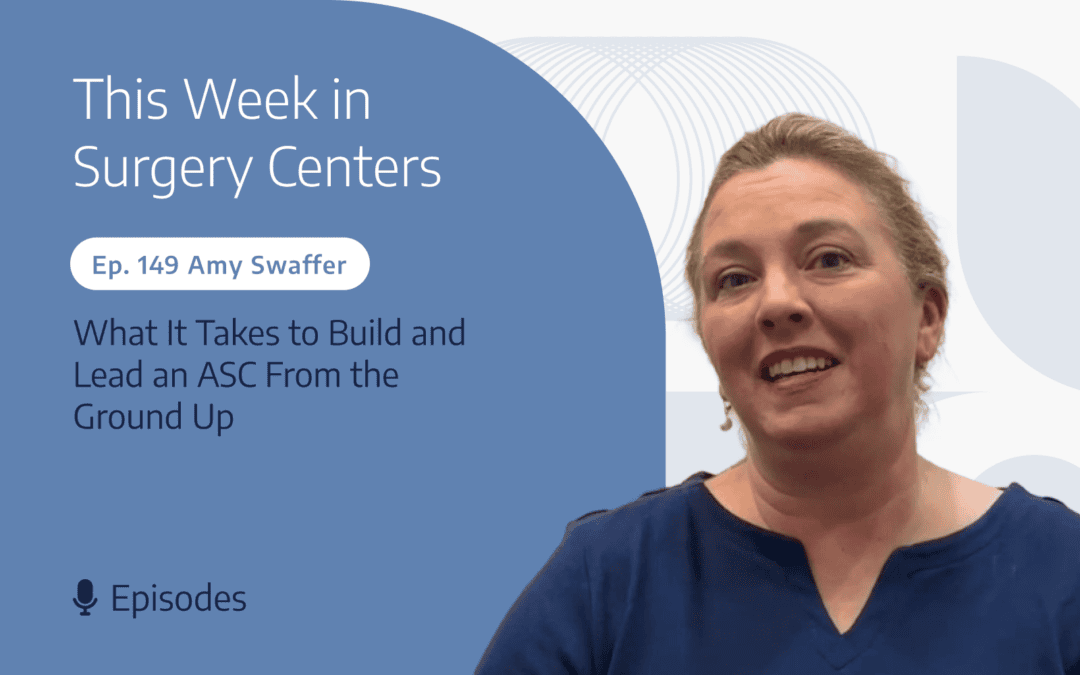



Ep. 149 Amy Swaffer – What It Takes to Build and Lead an ASC From the Ground Up
Here’s what to expect on this week’s episode. 🎙️
Amy Swaffer, Director at Knoxville Spine Surgery Center, joins us from HST Connect to share what it took to move from 22 years at a Level I trauma center into the ASC industry and help build a de novo surgery center from the ground up.
Amy breaks down the learning curve that comes with entering the ASC world, why she surrounded herself with people who were stronger than her in key areas, and how her team built workflows around both patients and staff. She also shares her approach to leadership, supporting employees, and listening to the people doing the work every day to identify opportunities for improvement.
We also get into how Knoxville Spine Surgery Center responded when its original anesthesia group could no longer provide coverage. Amy explains why the center ultimately built its own anesthesia group, the benefits they’ve seen from having that relationship in-house, and what ASC leaders need to consider around staffing, coverage, and communication before taking a similar approach.
Then, we’re covering some of the latest news impacting the ASC industry, including insurers steering certain elective procedures toward ASCs, CMS’s new CJR-X joint replacement model, and increased regulatory scrutiny surrounding ASC acquisitions.
Plus, HST Pathways has been nominated in several categories for the inaugural Ambulatory Surgery Center News Product of the Year Awards. Voting is open through September 30, and we’d really appreciate your support.
And to end things on a lighter note, we’re looking at new research on how therapy dogs are helping patients stay engaged and active during stroke rehabilitation.
Resources Mentioned:
ASCN Product of the Year Awards – Vote for HST Pathways
CJR-X Comprehensive Care for Joint Replacement Expanded Model – CMS
FTC Approves Final Consent Order in Ascension Health-AmSurg Deal – Federal Trade Commission
Brought to you by HST Pathways.
Episode Transcript
[00:00:00]
Ryan Cohn: Hey everyone. Here’s what you can expect on today’s episode. I sat down with Amy Swaffer from Knoxville Surgery Center during HST Connect to talk about what it really takes to build and lead an ASC from the ground up
amy spent 22 years working at a level one trauma center before making the jump into the ASC industry and helping launch a brand-new surgery center. We talk about what that transition was like, what she had to learn along the way, and why building the right team around you is so important
We also get into some of the lessons Amy learned while opening the center from building workflows and choosing technology to creating a culture where employees [00:01:00] actually feel supported. And one of the most interesting parts of the conversation is how Knoxville Surgery Center ended up building its own anesthesia group after their original anesthesia partner could no longer provide coverage
So if you’re new to the ASC industry, in the process of building a de novo center, or you’ve ever considered building your own anesthesia group, this episode is definitely for you
Make sure to stick around after my conversation with Amy because we have a lot to cover in this week’s news
We’re talking about insurers getting more aggressive about steering procedures toward ASCs, a major new CMS model that could impact the future of outpatient joint replacements, and what increased regulatory scrutiny of ASC acquisitions could mean for the industry as a whole
Plus, we’ll wrap things up with a much lighter story involving stroke rehabilitation and a few very good dogs
I hope everyone enjoys this episode, and here’s what’s happening this week in surgery centers
Amy Swaffer: So, [00:02:00] 22 years ago, I started at a level one trauma center at UT Medical, and I’ve worked with the same group of surgeons this whole time. They had an idea to open an ambulatory surgery center and approached me with that. And thought that I might like the transition from trauma to an ambulatory setting since I’ve done trauma for so long, so…
A- and I’m honored that they have. They trusted me with this brand-new baby that they’re- that they were opening, so it’s been a fun adventure.
Ryan Cohn: I bet it has. It’s also sound like- sounded like it’s been a, a stressful and a lot of work for you- Oh, yeah … coming from a- All the things.
Yeah. So talk about that transition from working at a level one trauma center, you said-
Amy Swaffer: Yeah …
Ryan Cohn: to, to an ASC. What was that like?
Amy Swaffer: I think it gave me a lot of tools to use to transition to the ambulatory surgery center. So, in, in trauma situations you have to learn to anticipate to think quickly on your feet to communicate with different departments different personalities and take care of a patient at the same time.
So, those things I had going for me.
The [00:03:00] other things that I had to learn were what I’m used to having the hospital do, so they have huge departments that deal with quality, departments that deal with the pharmacy situations. Things like that, th- that you are now dealing with. So, it’s a lot.
It’s a lot and y- it makes you appreciate, those departments doing those things for you when you’re in the hospital. But it’s also really cool to be able to customize them and to kind of pare it down to what you’re focusing on at your center, so.
Ryan Cohn: That makes sense. I mean, it sounds like you, you basically had to put on your entrepreneur hat and-
Amy Swaffer: Yes
Ryan Cohn: and learn a bunch of skills and wear a bunch of hats and- … kind of step outside your comfort zone to some degree and-
Amy Swaffer: Oh, absolutely. Absolutely. But I had a lot of people that helped me out, so, I’ve been a long-term member of AORN and recently in the last few years an ASCA member. Going to conferences building up those friendships with other people that do what I do and reaching out to them and leaning on them pretty hard.
And that’s really helped-
the whole process, so. Yeah.
Ryan Cohn: I bet. [00:04:00]
Amy Swaffer: Yeah. Networking’s huge. So if y- if you haven’t done that, you should really do that ’cause you never know when you’re gonna need it in the future too, so- … that, that’s helped a lot.
Ryan Cohn: Well, and it sounds like that’s how you got this opportunity was- Based off of who you knew and your network
Amy Swaffer: and- yeah
Ryan Cohn: Otherwise, you know-
…
Ryan Cohn: You may never have gotten the opportunity.
Amy Swaffer: That’s exactly right, ’cause I mean, coming from a level one trauma, who would pick somebody like that to open a center? So, I felt very honored that they knew I had it in me to do it,
Ryan Cohn: so.
Amy Swaffer: Yeah.
Ryan Cohn: Yeah. Well, don’t you think that’s…
you’re kind of like the perfect fit for maybe opening up an ASC having that much experience inside of a hospital or-
Amy Swaffer: Yeah, definitely the intraoperative portion of things. so it’s helped me with a lot of things. It’s helped me with the materials management part of things building our trays and the clinical work that happens in the operating room.
The, the rest of it, I tried to hire people that were way smarter than me at other areas. So like pre-op area, sterile supply those things I knew a little bit about, but not not to be able to make policies and procedures around those things. [00:05:00] And so, that helps too, to hire people that are smarter than you in the areas that you are lacking in.
So- Yeah … that’s huge.
Ryan Cohn: Absolutely.
So which parts of hospital leadership prepared you the best, would you say, for running an ASC?
Amy Swaffer: I think just my role in the intraoperative area because the, the materials management part of things is huge. So when you know the physicians and their procedures, what they like to use on their procedures and the instrumentation that they like to use that’s huge.
And even in the cost savings p- portion of things, instead of just buying in bulk, just in case, let’s use this, I was really in tune to what they used and was able to kind of build materials management around that.
So, I think that, that was my biggest-
…
Amy Swaffer: Part.
Everything, a lot of the other things I just kind of learned on the way.
And went to classes, and webinars, and conferences, and continuously learning and building on that I didn’t know, so.
Ryan Cohn: Yeah. And I know in previous conversations you’ve mentioned learning the language of ASCs- Yeah.
was [00:06:00] something that w- was like a sticking point for you.
Amy Swaffer: Yeah. ASC folks speak in acronyms. So, when I first went to my very first conference, it was really strange. I looked up a lot of acronyms because-
…
Amy Swaffer: That’s just, that’s how they spoke. But after a couple of years, it’s become normal to me.
And I know what they’re saying now. It’s so nice. I can speak the language now. But it is definitely something that you have to get used to.
All of the acronyms.
Ryan Cohn: Yeah. It is. I- it took me quite some time- Yeah … to learn everything, and still learning. Yeah. There’s new ones that pop up almost every day or week.
Amy Swaffer: Absolutely. Absolutely. Yeah. I still look up a few from time to time, so.
Ryan Cohn: Whenever one comes up, it’s… I try to go to ChatGPT as soon as possible.
Amy Swaffer: Yeah. That’s super handy. So yeah. It is. I do that too.
Ryan Cohn: That’s funny. And so what would you recommend to someone that, would want to move over to an ASC setting?
What would you recommend that they get into first, they learn? What should they consider?
Amy Swaffer: I feel like when you first step into the role, it’s super overwhelming just because there’s so many things to do. [00:07:00] And I feel when you first go over, y- you don’t need… you kind of feel like you need to do everything.
But you don’t. You don’t need to know everything. You don’t need to do everything. Like I said, you need to hire people that know other things that you don’t know. You need to go to conferences and webinars and figure the other pieces out. But it’s definitely, you’re kind of building the plane while you’re flying it the whole time.
So, just don’t feel like you have to do everything at once.
Learn little pieces at a time. But it is quite overwhelming at first.
So, I, I could see where people would get really frustrated-… at it. But it just takes time to get used to things.
Ryan Cohn: Yeah. Oh, I think- And learn
totally. And, I guess as you moved over and you were building the plane as you, you were flying it- … and you were looking for people that could fill in the gaps for you-
…
Ryan Cohn: How did you go about finding those people and sort of determining what those gaps for your knowledge or your expertise were?
And you kind of have to re- it’s It’s sobering, realizing- … “okay I really don’t know this.”
How did you [00:08:00] kinda- Yeah … go about that?
Amy Swaffer: Actually, I think I got really lucky. I got really lucky. Friends with the right people that brought people to me and were like, this person does a really good job and y- you might need to talk to this person.”
And we sent out a messages through Indeed to try to find people too. Filtered through some of those resumes. And just for example the lady that we have that runs our sterile supply department, she’s amazing.
Came from California knows all the rules and regulations and wants to do the best job possible-
…
Amy Swaffer: And follows all the rules so we don’t get- … in trouble with it, ’cause I don’t know the rules. And I’m re- Interesting … leaning on her to know those rules. We sent her to A-A-M-I- … I think is the sterile processing. So just standing behind those people and supporting them, sending them to conferences as well so they can learn-
more about that side of things. I think that’s great. You gotta support your people.
Ryan Cohn: Totally.
Yeah. I mean, that’s what I think the best leaders in the world are able to realize that, they aren’t an expert in everything.
I mean, that’s what the best CEOs do. Yeah. That’s what, [00:09:00] leaders of of our governments do. Yeah. And you have to have your subject matter experts so-
Amy Swaffer: You do,
Ryan Cohn: for sure … I think you, that makes you an expert- … for being able to do that, So, we were talking earlier, and this is kind of a sidestep, but you mentioned that you guys started your own anesthesia group, and-
Amy Swaffer: Yeah …
Ryan Cohn: I think that’s something really interesting that we should- Yeah … talk about. So y- what sort of led you guys to going down that path as opposed to, continuing to partner with another anesthesia group?
Amy Swaffer: So funny enough, we were at the ASCA Conference and, we were socializing and learning and doing all the things, and in the middle of it, we received a phone call. And it was a phone call from the group that we had in place to start our ambulatory surgery center, and unfortunately, they were not able to commit to that.
And so we lost that group and we were crushed about it- … and didn’t really know what to do about it. And so, we had fun at the conference and learned a lot, and then when we got back home, it was time to start thinking about what we really [00:10:00] wanted to do. And that was the next logical step- to be honest. So, started that and it’s been the best thing. It’s been the best thing.
We can control the controllables. Our anesthesiologist that is taking care of all of our patients, he actually does the pre-op phone calls.
Patients love that. And also, it’s great too because he already knows all the patients when they come in.
He’s had a conversation with them. And if there’s something that’s wrong and they need additional testing, that’s addressed right then, right when he makes that phone call. So it also helps with, delaying a surgery, a possible delay. You can go ahead and send them for the testing and make sure everything’s okay.
And if they’re okay to come to the surgery center, that’s great, but if they need a higher level of care, then we know that- … and we can go ahead and send them. And it makes the process a little bit quicker, I think.
Ryan Cohn: That makes sense. I mean, there’s just less phone tag, basically.
Amy Swaffer: And it also helps me too. So, say if we had incidents with urinary retention or something, and it was a PACU [00:11:00] situation, how can we help prevent this? Or, I don’t have to go through a lot of… I just go straight to him.
And we have a discussion about it, and then we bring in other team members to see what we can do to fix the problem because, it he’s the communication.
It’s amazing.
I love it.
Ryan Cohn: So had you guys already started? You had already opened your doors and- … the previous group-
…
Ryan Cohn: They had dropped it before you guys- Correct … had started. What was the reason for that, if you don’t mind sharing?
Amy Swaffer: I think that it was staffing.
Ryan Cohn: Okay.
Amy Swaffer: I do believe.
Ryan Cohn: So it was just a limitation of what they could actually cover.
Amy Swaffer: Correct. They were covering- Interesting … a, a major hospital, and then they were also covering several ambulatory surgery centers.
And I think it was us and another ambulatory center-
Ryan Cohn: Wow …
Amy Swaffer: they weren’t able to pick up.
Ryan Cohn: And you were saying that this is sort of becoming a, a more and more common thing for ASCs, from what you’ve heard?
Amy Swaffer: When I’ve gone to conferences, and anesthesia surely is one of the top conversations. Yeah. Yeah. And it is definitely the elephant in the room-
With a lot of things. And I feel very privileged [00:12:00] that we have what we have going for us. It’s really working out. And it might not work out for other people, but it works out for us.
Ryan Cohn: Interesting.
That’s, and for most ASCs, it’s a struggle. So, to hear bringing it in-house sort of you weren’t even planning for it, but it just, it was like a blessing in disguise. It
Amy Swaffer: was.
Ryan Cohn: Any- anything else that you think people should know about starting your own anesthesia group?
Amy Swaffer: Well, you have to make sure you have coverage for vacations, lunches, stuff like that.
So we do have PRNs in place-
…
Amy Swaffer: That come and do those things. So, you can’t just hire an anesthesiologist and a couple CRNAs and just go for it. You have to have breaks and lunches and and vacation time. You have to make sure you’re covering all of that-
and that you have people that can come in and do those kind of things for you.
So, yeah.
That, that’s probably one of the bigger things, just make sure, ’cause if you don’t have anesthesia, you’re not really doing any work. So-
You have to make sure those things are covered, and you give those people breaks and-
Ryan Cohn: we’ll change topic a little bit, and I wanted to get back to you, starting your center. So, in a hospital, leaders are [00:13:00] often handed an entire system- … and and just told how to use it. But when you were asked to come and start a, an ASC, you kinda had to build that, that whole system up- from the ground up. So- Yeah … talk, talk to us about what that process was like.
Amy Swaffer: Well, we wanted to make sure we chose, what we wanted. And so we did a lot of homework on the back end, but we wanted to make sure we could take care of the patient from the time they entered our doors to the time they left, and the workflow was easy to do.
I think easy is the biggest thing for me ’cause I’m not that great at computers. So, having it be able to, chart really easy you have the green check mark saying that you’re completed in that area as easy as you can make charting is what I like. And I felt like it was pretty easy to use HST.
Ryan Cohn: Yeah. Yeah, that makes sense.
Amy Swaffer: Yeah.
Ryan Cohn: And so when you were, when you were evaluating those, those options out there, I assume you were probably looking at it from a nurse’s lens. “This is what I would want- Yeah … in my own system.” What other things did you realize [00:14:00] in that process that you’re like, “Okay.
Wow, I… It’s not just about charting, though.
Amy Swaffer: Well, I feel like your computer system is like your roadmap.
So, like the connective tissue- … so to speak. But it gives you a, a map on how your patient is supposed to go through your center.
And when we were first doing it and we had our first few patients through, we would stop back and… stop and look back and say, “What was easy? What was hard? What do we need to change?”
“
Amy Swaffer: What was excessive about what we were doing with the computer?” And then as we started doing more and more cases, you just ask the people that are working the system.
So everybody that works with us, you stop and ask, “Where’s the bottlenecks?”
“
Amy Swaffer: What’s happening? What are we doing repetitively? What’s, what are we making hard? What can we fix to make it easy?”
And so, you go through and ask all those questions and try to g- ’cause you customize it and you think, “Yeah, I’m ready to go.”
But then when you actually move patients through it-
…
Amy Swaffer: It’s a little bit different of a view.
And and once you start moving more and more patients through, you… I felt like we needed to stop every now and again and [00:15:00] just reevaluate what we were doing-
and and redo some charts. And my pre-op manager, nurse manager, she’s great at computers and those were some of the, the things that she would do.
She would- … help us clean things up on that end. So- Yeah … lot, a lot of phone calls to HSD and help on that end, too to try to make it what we wanted it to be. Yeah. And the least amount of charting, covering everything that we’re supposed to cover get the patients in and out the door as easy as we can-
while making it easy for the staff to use as well.
We had one issue where we were using the system to tell people the text system to tell people when to show up for surgery.
And we kind of entered everything in and didn’t really have a second thought about what time we were sending that out. And we had some complaints.
Patients called and were like you’re sending me this really early in the morning.” And so we had to go back and what makes sense for us doesn’t usually make sense- … for a patient on the other side of things. And so, that again is where Press Ganey kind of helps you too. You go through and you read those comments, and [00:16:00] it’s like, well, we can apply that too to what we’re doing-
at the center to try to make things better, so, you use all your different resources to try to help make your EMR what you want it to be.
Ryan Cohn: Totally.
And for managing, I’m sure you realize that there was, managing inventory- … and coordinating your cases and just everything that goes along with it.
What other lessons did you have during that first six months that came up? Anything else that you’d want to share?
Amy Swaffer: Just to make sure that you’re doing everything that’s right for the patient and for the safety of the patient.
And to… I think we built our surgery center around our patient and around the people that are working there, ’cause we wanted it to be a good place to work.
We wanna take care of patients and do great clinical work as well.
So, as long as you have your focus on that, I think everything else kind of works itself out.
So.
Ryan Cohn: What are some tips for making it a great place to work for your employees and a great place for your patients? Yeah. What are some things [00:17:00] you guys have done?
Amy Swaffer: very much a servant leader.
I kinda lead from the pack. So, most days I’m rarely in my office. I’m in scrubs- … taking care of patients too making sure our staff is taken care of. We wanna make sure everybody gets out at the time that they need to be out. I learned that in the hospital setting. So-
…
Amy Swaffer: When somebody gets off at 3:00, you don’t need to let them hang around till 5:00 and keep working.
You need to- if that’s happening, you need to hire more people or rearrange schedules and things like that. So, we wanna make sure people still have a great work/life balance. And it takes some hard work to do that-
but it really helps. It helps people. Because you gotta have a job.
It’s hard times.
You gotta work. I gotta work. But y- you don’t have to, center your life around it.
Yeah.
So, but I’ll go in and if the nurses are in procedure rooms and they’re gonna be staying late, I’ll go relieve them and make sure they go home on time.
Wow.
And make sure they get lunches if we have call-ins and people on PTO and things like that.
So, always take… I- [00:18:00] if I take care of my people- … they can take better care of the patients. So I feel like- … that’s what I need to work on, is to take care of all of my people. And if I do that, then everything else is easy.
I mean, they’re gonna take care of the patients
Ryan Cohn: that makes so much sense you’re paying it forward. And I know when I’m happy, I’m my best self, for sure.
Amy Swaffer: Yeah. And our anesthesiologist, he helps too.
He’s definitely a part of leadership as well and he gets in there too and helps and helps take care of patients and and- … and relieves some of that off of folks too. So he’s always… Yeah, he carries his laptop around, and he moves around the center, and he’s always available in there.
And so, he… we’re a lot alike in that realm. So- Helping, helping each other out and helping our folks out. .
Ryan Cohn: And I think, good leadership really is the key to making a successful business- Yeah … and a successful ASC.
Amy Swaffer: I wouldn’t even know how to micromanage. I have no idea.
Ryan Cohn: I mean, micromanaging is- it’s a common thing ’cause you- I have no
Amy Swaffer: idea.
Ryan Cohn: Yeah. It’s tough. It’s [00:19:00] tough working. I’ve worked in those settings before and- I wouldn’t know how to do it … it makes you wanna rip your hair out. Yeah.
Amy Swaffer: I wouldn’t know how to do it, so.
Ryan Cohn: That’s part of hiring good people too is- is you can trust them to just do the work-
…
Ryan Cohn: That they know how to do.
Amy Swaffer: Yep. You gotta take care of your people, support ’em-
And send out education. So we’re getting ready to start doing some lumbar fusions here in the near future and, … we’re partnering with a nearby rehab physical therapy-
Group, and they’re gonna come in and do some education for our nurses, show them how to walk walk patients with a walker. … I feel like PACU and other areas may not do that. When you’re in a hospital setting, you have PT that comes and does it. So- … to make sure they have their appropriate education and feel good about walking those patients after they have surgery done.
So things like that- Interesting … you gotta make sure they have the education and the foundation to be able to do the job that you’re asking
Ryan Cohn: them
Amy Swaffer: to do. Yeah. And so that’s another way
Ryan Cohn: So knowing what you know now, what would you do differently if you were to go start an ASC from scratch again? Oof. [00:20:00]
Amy Swaffer: So many things. I mean, we had someone helping us along the way, which was…
I don’t know how we would’ve done it wi- without them. So, we had someone leading our path, which was amazing. But everything takes longer than you think it’s gonna.
Whether it’s ordering equipment C-SaaS took a long time. But just plan for those things to take a minute. It’s gonna take a little bit.
Yeah. So that is one thing. A- and he kind of told us that, too. He was like, you need to start on this ’cause it’s gonna take a little bit.” So, so he gave us that heads-up- … but I, I had no idea it was gonna take as long as it did. But
Ryan Cohn: yeah.
Amy Swaffer: . So definitely that. Watching what takes so long. Equipment. C-SaaS was huge. That took a long time. I think just planning for those gaps-
…
Amy Swaffer: And what you can do in those gaps. We only hired a small group of people, so there was about five of us-
…
Amy Swaffer: That was actually doing the startup on things with the policies and procedures and going through the building and [00:21:00] making sure everything was the way it needed to be and ordering supplies and buying the racks and putting them together and doing all that stuff.
So we didn’t really start with a huge staff of people. We started with a very small… We started with myself our pre/post-op manager our SPD manager.
Ryan Cohn: Okay.
Amy Swaffer: And, Wow … yeah, a couple other folks, and that was about it.
Ryan Cohn: Yeah.
I mean, you gotta start scrappy and small and- … hire as you go, so.
Amy Swaffer: Yeah, or you don’t have anything t- to do. It’s hard to spread all that out. I mean, there’s plenty to do, but-
…
Amy Swaffer: It’s hard to delegate certain things ’cause there’s certain things you really need to do.
Ryan Cohn: Yeah.
Amy Swaffer: But but yeah, there… We were all really busy, so.
Ryan Cohn: Oh, I bet.
Amy Swaffer: But it did.
There was a lot of things that took a lot longer than we thought. Yeah. So I think that’s the biggest thing, is to get going on those things early- Yeah … in the process, so.
Ryan Cohn: Makes sense.
Amy Swaffer: Yeah.
Ryan Cohn: And we do this last question
what’s one thing that our listeners can do this week to improve their surgery centers?
Amy Swaffer: I think the biggest thing is to listen to your people.
The people that, that work in the OR, the ones that- [00:22:00] Run the front desk, the ones that are in SPD pre/post-op, interop what are they running into that is, that needs changing?
You can learn a lot from just a sit-down conversation with everybody to- Yeah … to see, what changes need to be made. What are your frustrations? What are we not doing good? What could we do better?
Yeah.
So just having those frank conversations and having an op- open door policy to those kind of things.
I, I feel like anybody on my team would come into my office and tell me anything they wanted to tell me. So- That’s awesome … but but you learn from that, and you can fix things and ease those frustrations and smooth things out a little bit. And it doesn’t just help everybody that you’re working with, it helps your patients too, so.
Ryan Cohn: Yeah. Absolutely.
Amy Swaffer: Yeah.
Ryan Cohn: Well, great advice, Amy. Yeah.
Amy Swaffer: Thanks so much for coming on.
Ryan Cohn: Thanks again to Amy for joining me at HST Connect and sharing what she’s learned from building and leading Knoxville Surgery Center. [00:23:00] I really liked her point at the end about listening to your people, whether you’re opening a new center or trying to improve one that’s been operating for years. The people doing the work every single day usually have a pretty good idea of where the friction is and what can actually be better in your center
but before we get into this week’s news, I wanna ask a little support from everyone listening HSC Pathways has been nominated in several categories for the inaugural Ambulatory Surgery Center News Product of the Year Awards, and voting is now open through September 30th
If you’d like to support us, we’ll include a link to the voting page in this episode’s description
You do need to be subscribed to Ambulatory Surgery Center News in order to vote, but subscribing is completely free, and once you’re subscribed, you can review this year’s nominees and cast your ballot
And if HST has helped your surgery center, we’d really appreciate you taking a minute to vote for us. And as always, thanks so much for listening and supporting the show. Now let’s go ahead and take a look at the latest news [00:24:00] impacting the ASC industry First, we’re seeing another sign that payers are getting more aggressive about steering appropriate procedures towards ASCs Independence Blue Cross and Highmark have both implemented policies designed to favor ASCs, ASC
Independence Blue Cross and Highmark have both implemented policies designed to favor ASCs for certain elective procedures. The reasoning is pretty straightforward. ASCs can provide many of these procedures at a lower cost than hospital outpatient departments while still delivering high-quality care, if not even better care What’s especially interesting is how health systems are responding to this
according to Ambulatory Surgery Center News, some health system leaders see the shift as an opportunity to move appropriate cases into a more efficient setting. Others, on the other hand, are pushing back because they can receive higher reimbursement for those same procedures [00:25:00] inside of a hospital outpatient setting But for ASC leaders, the bigger takeaway here is that site of service isn’t just being driven by patients, physicians, or even CMS anymore.
Payers are actually becoming more active participants in deciding where appropriate procedures should actually happen
And that makes payor relationships, contracts, available capacity, and your ability to demonstrate quality even more important as the shift to outpatient care continues. Next, there’s a major new development in joint replacement reimbursement CMS has finalized an expansion of its comprehensive care for joint replacement model called CJR-X.
Beginning January 1st, 2028, most eligible hospitals nationwide will participate in the model for hip, knee, and ankle replacements performed in inpatient and hospital outpatient settings. Hospitals will be financially responsible for the quality and cost of that care through the first 90 days of a patient’s recovery.
[00:26:00] Now, ASCs aren’t directly participating in CJR-X, but I still think it’s worth paying attention to. The model puts even more emphasis on coordinating the entire episode of care and determining where that care can be delivered efficiently For ASC leaders doing total joints, it’s another example of reimbursement moving toward accountability for the full patient journey rather than just the individual procedure And as these models evolve, understanding your costs, your outcomes, and where your center fits within that broader care continuum is only going to become more and more important.
Our third story is another sign of just how closely the ASC market is being watched from an investment and regulatory perspective.
The Federal Trade Commission has finalized the divestiture requirement tied to Ascension’s three point nine billion dollar acquisition of AmSurge. As part of the final order, Ascension is required to divest six [00:27:00] AmSurge-owned surgery centers across Tennessee, Oklahoma, Texas, and Kansas to SCA Health.
Another ASC was required to be sold as part of the broader transaction. And the FTC’s concerns were that owning those centers could reduce the competition in certain local markets.
For the industry overall, I think it’s another important reminder that as ASCs become a larger part of healthcare delivery, deals involving surgery centers are going to attract more and more attention from regulators. We’re seeing more investment in the space, more consolidation, and more organizations competing to build their outpatient footprints.
But growth of that scale also means regulators are going to look closely at how individual transactions affect competition within local markets.
And finally, let’s end with something a little bit lighter
Researchers at Mayo Clinic recently looked at whether therapy dogs could actually improve inpatient stroke rehabilitation. Patients who [00:28:00] participated in rehabilitation sessions with therapy dogs showed greater engagement, increased physical activity, and spent more of their sessions being mobile And when you think about it, it makes total sense.
Instead of just asking a patient to walk down a hallway, they might be walking with a dog, playing fetch, or interacting with the animal as part of the therapy. So apparently, one strategy for getting patients more excited about physical therapy is pretty simple: just add a dog
I’m not sure that solution obviously translates directly to the ASC setting, but I’m guessing there’s probably at least a few people listening out there who wouldn’t complain about having a therapy dog roaming around their center. And on that note, that’s all we have for this week.
Thanks again for listening to This Week in Surgery Centers. If you found this episode at all helpful, you enjoyed listening to it, we’d really appreciate it if you share it with a friend or a colleague. It’s the best way to support the podcast and help us grow. We’ll see you again next week
[00:29:00]