
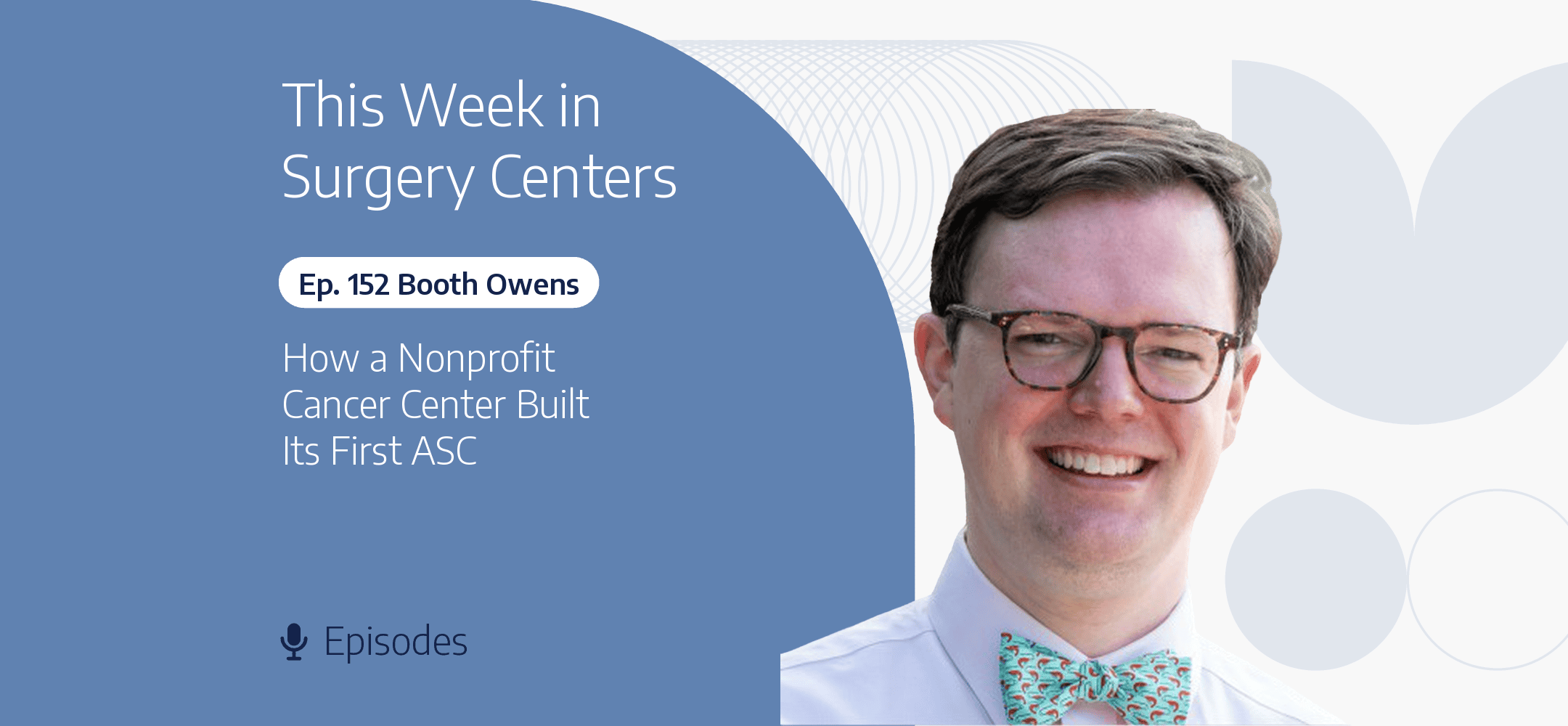


Ep. 152 Booth Owens – How a Nonprofit Cancer Center Built Its First ASC
Here’s what to expect on this week’s episode. 🎙️
Booth Owens is the EMR administrator at CARTI Surgery Center in Little Rock, Arkansas. CARTI is a nonprofit cancer care provider, and Booth joined while its first surgery center was still under construction. Booth joins us this week to break down how CARTI opened its first ASC. He walks us through getting Medicare approval, convincing private payers to come on board, why the lobby has a fireplace and a pastoral care team, and how the center decides which specialties to add. He also shares what he’d tell a team planning its first ASC.
In our news segment, we’re talking about the final 2027 Medicare payment rule for ASCs, a new House bill that would replace No Surprises Act arbitration, and a surgeon who removed a tumor through a patient’s eye socket. We’ll connect each story to what it means for ASC leaders where it applies.
Resources Mentioned:
Guest Discussion
CARTI Surgery Center – https://www.carti.com/locations/carti-surgery-center/
News Recap
2027 Medicare ASC Rate Impact Calculator (free spreadsheet) – https://www.hstpathways.com/resources/medicare-asc-rate-impact-calculator/
Brought to you by HST Pathways.
Episode Transcript
Ryan Cohn: [00:00:00] One thing I think is really interesting about your center and your organization is that you guys are a nonprofit, which is pretty uncommon for ASCs, at least to my knowledge. How does that change how you guys operate as a surgery center?
Booth Owens: The Car TI Surgery Center, the whole reason that we extended our services into this setting is we had patients that would tell our surgeons and their medical oncologists that the only thing they would change about their cancer journey is that they would have liked to have had their surgery at a CARTI facility.
We can only hear that so many times before we said, okay, how do we make that happen? Is that something we can do?
Show intro: Welcome to This Week in Surgery Centers. If you’re in the ASC industry, then you’re in the right place. Every week we’ll start the episode off by sharing an interesting conversation we had with our featured guest.
And then we’ll close the episode by recapping the latest news impacting surgery centers. We’re excited to share with you what we have. [00:01:00] So let’s get started and see what the industry’s been up to.
Ryan Cohn: Hey everyone, here’s what you can expect on today’s episode. This is the very last episode from our Live from HST Connect series. And today’s guest is Booth Owens, who is the EMR administrator at CARTI Surgery Center in Little Rock, Arkansas.
CARTI is a nonprofit cancer care provider, and Booth joined while its first surgery center was still under construction. He walks us through getting Medicare approval and convincing private payers to come on board. He explains why the lobby at CARTI has a fireplace and a pastoral care team, and how the center decides which specialties they end up adding.
He also shares what he’d tell a team planning to build its first ASC and one habit that helps him keep close to all of his staff. After the interview, we’ll get into the news. CMS has finalized its [00:02:00] 2027 payment rule for surgery centers and we’ll give you our take on it.
A new House bill would replace the No Surprises Act arbitration, and we’ll close with a surgeon who removed a tumor through a patient’s eye socket. I hope everyone enjoys the episode, and here’s what’s going on this week in surgery centers. So good to see you again.
Booth Owens: Yeah, you too.
Ryan Cohn: Can you go ahead and introduce yourself and what you do and where you work and all the things?
Booth Owens: My name is Booth Owens. I’m the EMR administrator for the CARTI Surgery Center in Arkansas. CarTI is the largest independent cancer care provider in Arkansas, and we’re a nonprofit, and we bring trusted cancer care accessibility across the state through compassion, innovation, and purpose. I love it. And I love working there.
Ryan Cohn: That’s awesome. How long have you been there?
Booth Owens: So I’ve been [00:03:00] there four years in September, and they brought me on because we were gonna build an ASC, which was already under construction at that point, but we built a new building across the street from our Little Rock Cancer Center.
It was a whole new thing for our organization. So there was a lot that went into that.
Ryan Cohn: You were basically there when the ASC was being built from the ground up. Did you have a background in healthcare? I’m curious to learn a little bit more about that.
Booth Owens: I’ve worked in healthcare for about 15 years, I think now. Wow. I started on the revenue cycle side of things and eventually transitioned to what I do now, the clinical systems support, training, and everything that goes with that.
Of course, when they opened the surgery center, they had already vetted that the existing EMR we have for outpatient office visits was not going to be sufficient. That was where HST came in and where I came in, and we went from there.
Ryan Cohn: [00:04:00] Sounds like you had to determine or at least help set up the systems and you’re heavily involved. You’re almost like the internal IT person for your systems for HST. What was that process like?
What did you learn? What was more difficult? What was easy?
Booth Owens: I think CARTI made it really easy because when they took on this project of building a center, they brought in industry experts. Of course, we hired AVP of the surgery center, and she had decades of experience in the surgery center setting and brought that with her.
We hired an anesthesiology chief. We also had a project manager who helped a lot with organizing the team and making sure everybody’s roles were well defined so we could be successful. I was gonna say, too, one thing that we really benefited from is we have 18 locations in Arkansas. Wow. We already had a pretty good scale of our organization.
Ryan Cohn: [00:05:00] What would you say are some of the things that you guys have learned when opening a surgery center? What would you do differently the next time around?
Booth Owens: I think we were really focused on the patients and how they would move through the center when we set everything up. And we were successful with that. What we then figured out is we still need offices.
We still need conference rooms, those things in storage. And we planned all of it, but we realized the needs that we have for those different spaces are different than what we expected. So we had to pivot and adjust.
We did really well because when you go to the center today, [00:06:00] none of those things are obvious.
But that wasn’t exactly by design, but it works for us. Having that flexibility, I think that’s one thing we would have changed is have planned for that a little better. And the storage part is like we have a lot of equipment that we use some of the time.
So it’s like, okay, we need to have this stored somewhere where it’s ready to be used at a moment’s notice, but isn’t in our way when we’re trying to work. So that’s another thing we’ve solved that problem. The walls are where they are. So we just have to work around that.
Ryan Cohn: Will the walls ever be torn down and redesigned? No.
Booth Owens: I don’t think so. We have part of the building that still needs to be finished, but we don’t know what we want to use that for. So at this point, we’re just like, just leave it as it is. If we find a use for that section, we’ll finish it out and use it.
Ryan Cohn: One thing I think is really [00:07:00] interesting about your center and and your organization is that you guys are a nonprofit, which is pretty uncommon for ASUs, at least to my knowledge. How does that change how you guys operate as a surgery center?
Booth Owens: The car tie surgery Center the whole reason that we extended our services into this setting is we had patients that would tell our surgeons and their medical oncologists that the only thing they would change about their cancer journey is that they would have liked to have had their surgery at a car tie facility.
We could only hear that so many times before we said okay how do we make that happen is that something we can do it’s been really beneficial especially the big demand was mastectomy cases and we can do those in the ASC.
Well at the CarTye Surgery Center we can do a mastectomy and the patient can even stay overnight in our center. Oh wow and I think our organization is pretty focused and [00:08:00] we have a really clear vision and a really clear aesthetic that we use for our services and how we do everything.
I think having control over what the facility is like is beneficial as well because what we’ve been able to do is have a boutique hotel atmosphere bar lobby has a gas fireplace carpeted chandeliers leather chairs it’s very nice.
Ryan Cohn: Wow I can see it makes you pretty happy talking about it definitely that’s very unique.
Booth Owens: It is not the cold atmosphere that some patients expect it’s very warm. They have big windows and landscaping so when they’re there they’re probably thinking about their surgery but hopefully they’re also enjoying the atmosphere and and it’s a little more calming than just sterile four walls.
Ryan Cohn: I’ve never seen a surgery center like that. It’s pretty cool. Is there a welcoming system that you guys have? Are they getting a coffee or water brought [00:09:00] to them?
Booth Owens: We have our receptionist and we do have a little cafe with coffee. That is definitely nice. And it’s so good that the staff sometimes avails themselves of that as well because we have an espresso machine type thing.
But one thing that I wanted to mention too that’s really cool is we have pastoral services. Almost every time I’m there, Larry is there, and he’s greeting the patients as well and being a resource if they are nervous about it or if they have anything they want to talk to them about.
And he doesn’t just do pastoral care, he also helps with logistics too. So when the family is ready to come see the patient that’s recovering, he sometimes is helping with that too. But he’s an ambassador for us there to greet the patients.
Ryan Cohn: The pastoral, I haven’t heard that term before. Is that a pastor?
Booth Owens: Yes, he’s a reverend.
Ryan Cohn: Oh wow. So cool. As a new ASC, I remember you mentioning that you first performed procedures for Medicare beneficiaries, [00:10:00] and you use that early experience to support conversations with private insurers. Could you walk us through that process a little bit?
Booth Owens: To get approval from CMS, which is Medicare, we had to do 10 pro bono surgeries. Wow. We did that.
I think our journey from nothing to surgery center was made a lot easier by some of these hurdles we had to pass. And of course, financially, it’s really difficult to have such an outlay and have the steps and the time between the steps, but we did the pro bono cases, we got our deemed status, we were able to bring patients in, and then, like you said, we did Medicare.
There’s a hundred surgery centers in Arkansas. I looked this up doing research for us to talk, but it’s still difficult for our organization, Car TI. We didn’t do surgeries, we only did them in hospital.
When we built our center and we started doing surgeries there, we had to convince payers to hey, we’re doing quality [00:11:00] work. You want to be in network with us, trust us, we’re gonna take really good care of your members. And it all worked out.
We’re set up, we’re in network with a bunch of these payers, but it still surprises our team sometimes that we can demonstrate that the cost of care is much lower at the surgery center, and the quality is just as good as the hospital.
Maybe better depending on the patient, because maybe they like going home after their surgery and not staying in a hospital. It’s tough because the hospital is kind of the default. And so we had to convince the payers or tell them, hey, and demonstrate we can do it cheaper.
Think about the money. They’re their goal is to take care of their members probably at the cheapest rate possible. It just makes sense.
But even with that, there’s a lot of hesitation there. That’s definitely something that we continue to work on just to get them [00:12:00] thinking that way.
Ryan Cohn: And that’s really interesting. I’ve never heard that you had to convince Medicare and CMS by doing 10 pro bono surgeries. Do you think that’s common across the ASC industry when opening a de novo?
Booth Owens: I know we had to get accredited through ACHC. Okay. And then we had to basically put all that in a packet and send it to CMS to grant us.
Interesting. And we also had our state stuff we had to do too, where they could say, okay, you can have people in your building and do all that.
Ryan Cohn: Once you had Medicare and you were approved and all that was good to go. Was it much easier to get the private insurers on board?
Booth Owens: I wouldn’t say so. No. It still was a few months just to do that.
Ryan Cohn: Oh my gosh. You’re fighting tooth and nail the AC to get that stuff taken care of.
Booth Owens: I wouldn’t say we were in a hurry, but we have patients that have needs. They have needs to have surgery. We’re open.
We can take the patients, but if there’s [00:13:00] no insurance, then it’s not going to work. But we did get it all resolved within a few months. But it was tough. We got through that, and our volume now is really good. So it’s going well.
Ryan Cohn: I would assume that’s just a common hurdle that most ASC leaders have probably gone through. It’s just not maybe well discussed or put out there. Thank you for bringing that forward.
For people that are listening that are interested in it, it’s just another thing to consider. Once the ASC was open, I would imagine your role expanded to what it is today.
Everything that you’re doing. How would you say the organization’s priorities changed after everything launched?
Booth Owens: I think we wanted to get in the center, start doing cases.
So we were super focused on that. What’s nice about that, a lot of the team we brought in had lots of experience already, but in doing that and preparing [00:14:00] for inspection, they’re learning all those workflows that they’re going to need once we start seeing more patients.
I think it went from, hey, let’s make sure we’re in compliance, we’re doing everything right, and then it’s how do we build our practice and make our practice see more patients? And then we’ve added specialties that we didn’t have.
We added urology, we’ve added gynecology, we now see some plastic cases. We did start with breast reconstruction, but now we do a little bit more, bigger scope there. Really putting some muscle on the bones of our center was the focus. How can we stay efficient but keep growing?
Ryan Cohn: Interesting. How did you determine those other surgery types or specialties that would make sense for you and your center?
Booth Owens: We are the only cancer-focused surgery center in Arkansas. That was always our first concern is to make sure we’re taking care of our patients. Adding things on, [00:15:00] some of it was pretty organic with the urology.
We brought several urologists in to the fold to our organization, and they’re doing outpatient visits. With that practice is going to come those procedures at the surgery center, and we love that we can do that in-house.
Just goes back to our original reason for opening the center. So then for gynecology, there’s some overlap that we know about with cancers there. So that was a good fit for us.
We have robotics available in our facility, and that’s a really good fit with gynecological procedures. And then we have a team in our organization that is really good at trying to forecast profitability for these different procedures and different specialties.
So anything that we thought about doing was going through that vetting process. And one thing that we were interested in and we haven’t pursued as of yet is gastroenterology [00:16:00] procedures. We have some colorectal procedures that we’re doing that we’ve added, which again is cancer focused.
As of yet, we haven’t made the math work. This is a fluid environment in healthcare.
Ryan Cohn: You have to be able to adapt, and like you said, it’s constantly changing. There’s new policies, payers are coming up with how much they’re able to reimburse or willing to reimburse. I’m curious to learn if you’re able to share what your team is looking at to forecast profitability on certain cases or when they’re evaluating bringing in new specialties.
Booth Owens: So we don’t have the claims data that we would like to have to really dive into it, but we do have some sources that we can use that are public. We do that.
It does affect me because whenever they’ve vet a procedure type or a case, it inevitably will come to my desk, and then [00:17:00] I’m doing the work to put this into practice in our EMR. Working with the intra op team on new preference cards, make sure all that gets done, working with the surgeon on all the orders that they need for the new cases.
It’s interesting because they do send me these folios sometimes where it’s especially with interventional radiology, there’s some things that we always want to do at the outpatient center, the car type cancer center, and some things that we always want to do at the surgery center if it’s possible.
It’s 100% on what’s the safest for the patient and what’s gonna keep our lights on, keep us functioning and able to provide the care.
Ryan Cohn: Makes sense. And I guess to bring it back to some learning lessons that you had when opening the ASC, and what would you recommend for organizations that are preparing to open their first ASC? What data and reporting processes should they establish from the beginning.
Booth Owens: Based on lessons that we learned at our center, I think really marrying the supply [00:18:00] chain and the intra-op teams operationally as early as possible because of course there can be shortages of supplies, there’s lagging things that happen there, but I think the biggest thing is we didn’t know what we didn’t know about some of those inter-op supplies and shortening that time and that communication between those two teams can help just in terms of we’re about to stock a whole room.
We know what we need but do we really know? Having everything be transparent from both sides, that’s gonna help a lot because I think everyone has different priorities. Of course we all have a common focus that we want this to be the best surgery center, but everybody’s priorities are a little different and having some transparency between those two groups I think is great.
To make sure that all the things we get are exactly what we need the right [00:19:00] number of supplies in a package sterile packaging all those things.
Ryan Cohn: It sounds like communication is just so important yeah for this.
Booth Owens: And I think part of what made us so successful is back to having a project manager who was running our meetings when we had all these different voices in the room. And that helps so much with designating roles. Everybody knows their role.
Everybody steps in where they need to step in. And then also some people need to be the ideas people, but then some days they can’t just be the ideas people, they also have to execute on those ideas. And we did really well with that. Having that structure is so helpful.
Ryan Cohn: I could see that. I guess it sounds like when you were first getting up and running, your project manager was probably coordinating a meeting on a weekly basis potentially. Exactly. So did that go on for the first year? Does that still happen?
Booth Owens: We don’t have that right now. It went on probably I want to six six months after we opened our
Ryan Cohn: [00:20:00] doors,
Booth Owens: but that’s probably a little more time. It probably felt like six months, but really it was only three or something. It was great though, because we had some government relations things we did where there was Congress people that came to tour the center.
And there’s a lot of plating that went into that, of course. We also had an open house for the whole organization to come and tour. But there was a lot going on throughout that initial period.
It was really helpful to have somebody that had all of those details in their brain and could keep everybody on the right track.
Ryan Cohn: Was that a third party person or contractor?
Booth Owens: They were with CARTI.
Ryan Cohn: That sounds like a really difficult thing to have. But yeah, someone that’s managing all of the departments and bringing people together like that.
Booth Owens: And managing not managing the construction, but managing our relationship with the vendor that was doing our construction. So that was helpful.
Ryan Cohn: That makes so much sense. Thank you so much, Booth. It’s just always a pleasure to talk to you and really appreciate you making the time [00:21:00] today.
I know you’re busy running around at the event, but got one more question for you. We do this every week. What’s one thing our listeners can do this week to improve their surgery centers?
Booth Owens: It’s kind of corny, but I learned in grad school about management by walking around. And I put that into practice most days. Just going into the center in each area.
And if everyone’s busy, I just keep going and go to the next section. But a lot of the time I find efficiencies that we need, and the staff will tell me. They’ll say, hey, we can do this more efficiently.
How do we do this in the system? But if I’m not seen and heard at the center, then I don’t always hear those efficiencies that we can create. So walking around and checking in is how I get a lot of good feedback. And I get a lot of insight that is necessary.
Ryan Cohn: Makes perfect sense. Nothing can replace face-to-face conversations and you creating an open environment [00:22:00] like that. Okay, I’m not gonna be offended if you give me feedback. Like this, what can I help you with?
Booth Owens: I’m kind of an IT person, so I’m kind of breaking the mold a little bit. The IT person’s in the data closet all day and no one sees them. So being able to walk around, I think that helps.
Ryan Cohn: I would agree. Well, thank you so much, booze. That’s great advice.
Welcome back. Let’s get into this week’s news. First, CMS has finalized its payment rule for 2027.
ASCs will get a 2.3% increase, which is a little bit lower than the 2.4% CMS proposed back in July. That 2.3% is an average across every procedure. So it doesn’t say much about any one center.
CMS also lowered a part of the rate formula called the weight scalar. And ASCA says the 10 most common ASC procedures will all be paid [00:23:00] less. CMS added 618 procedures to the ASC list, and it only kept the current update method through 2027, so what happens in 2028 isn’t quite clear yet.
We actually built a calculator here at HST using the final rates and it shows how different the results can be. Cataract surgery, for example, is the procedure Medicare spends the most on in ASCs, and its national rate drops about 2.8% or about $36 a case.
Arthroscopic rotator cuff repair goes the other way, up about 33.7%, and that’s because CMS now pays for it as a device intensive procedure. So I think the 2.3% doesn’t mean much on its own. What matters is which procedures your center does the most.
Before the new rate starts in January, it’s worth running your top procedures through the calculator, and it’s free on HST’s website and it just gives you a quick [00:24:00] estimate on what you could expect. Next, a new bill in Congress would change how payment disputes between out-of-network providers and insurers get settled under the No Surprises Act.
Representative Frank Pallone of New Jersey introduced it on October 8th, and he’s the top Democrat on the House Energy and Commerce Committee. Right now, when an out-of-network provider and an insurer can’t agree on a price, that dispute can go into arbitration.
An outside arbitrator then decides what gets paid, and the bill would end that for care starting January 1st, 2028. Instead, the insurer would pay a set rate based on the median of what it pays in network providers. It would have to pay within 30 days.
Pallone says a few high-volume providers have taken over that process, and according to his office, 10 provider groups filed about two-thirds of the 2.5 million disputes in 2025, and arbitrators awarded providers nearly $15 billion that [00:25:00] year.
And his argument for this is that it is pushing premiums up. Physician groups oppose the bill because they say it gives insurers more control over out-of-network rates, while consumer and employer groups mostly welcomed it.
Since Pallone is in the minority, analysts don’t expect action this year, although a narrower fix could end up in a year-end health package. The bill doesn’t mention surgery centers, but the law does cover out-of-network clinicians at in-network surgery centers, so those payment disputes would likely be affected.
For now, I just keep an eye on it. And lastly, an uplifting story from Albuquerque. The Albuquerque Journal reports that surgeons at Presbyterian Hospital removed a tumor by going in through a patient’s eye socket.
The patient, Kevin Puebla, is a 21-year-old college student. He was born with a rare tumor that doctors removed when he was a baby. And unfortunately, it had grown back.
He’d already had three skull surgeries by his first [00:26:00] birthday, and his surgeon said a fourth surgery would have risked more scarring and unfortunately brain injury. So they used a newer approach instead, and they made a small cut in the eyelid.
They moved the eye slightly and worked through that opening. The neurosurgeon, Dr. Michael Ortiz Torres, said they saw brain tissue for only about 10 seconds. And he said it was the first surgery like it in New Mexico, though the paper wasn’t able to confirm whether that was true or not.
The operation took about five hours, and Kevin was able to go home the very next day. He was back in class the following Monday, took a midterm that Friday, and before the surgery, the surgeons told his mother that they treat him like he was part of their own family.
And she called the whole thing a huge blessing. So that’s about it for this week’s episode. Thanks so much for listening to This Week in Surgery Centers. If you found it at all helpful, please share it with a colleague.