

Here’s what to expect on this week’s episode. 🎙️
Christina Murphy works in revenue cycle management at Surgery Partners, where she helps new surgery centers set up RCM workflows and technology. Christina joins us this week to break down why revenue cycle starts the moment a case is scheduled. She walks through what a center needs to build an accurate patient estimate, why early pre-service conversations matter for patients and facilities, and what revenue cycle decisions a new center should make before its first case. She also explains where automation and AI fit, from eligibility checks to prior authorization flags and op note documentation, and why human oversight still matters.
In our news segment, we cover the launch of the ASC Job Board, a new study projecting a growing surgeon shortage, and an update on Leapfrog’s public ratings for surgery centers.
Resources Mentioned:
ASC Job Board – https://ascjobs.hstpathways.com/
ACS press release, US Will Face a Shortage of Nearly 28,000 Surgeons by 2038 – https://www.facs.org/media-center/press-releases/2026/us-will-face-a-shortage-of-nearly-28-000-surgeons-by-2038-first-nationwide-study-finds/
Vizient forecast of ASC volume growth (ASC Focus) – https://www.ascfocus.org/ascfocus/news/digital-debut/202607-vizient-forcasts-continued-growth-in-asc-volume
Leapfrog press release, ratings for record numbers of hospitals and ASCs – https://www.leapfroggroup.org/news-events/leapfrog-group-publishes-ratings-all-time-record-number-us-hospitals-and-ambulatory
Leapfrog ASC Public Reporting Program – https://www.leapfroggroup.org/asc-program/welcome-asc-public-reporting-program
Brought to you by HST Pathways.
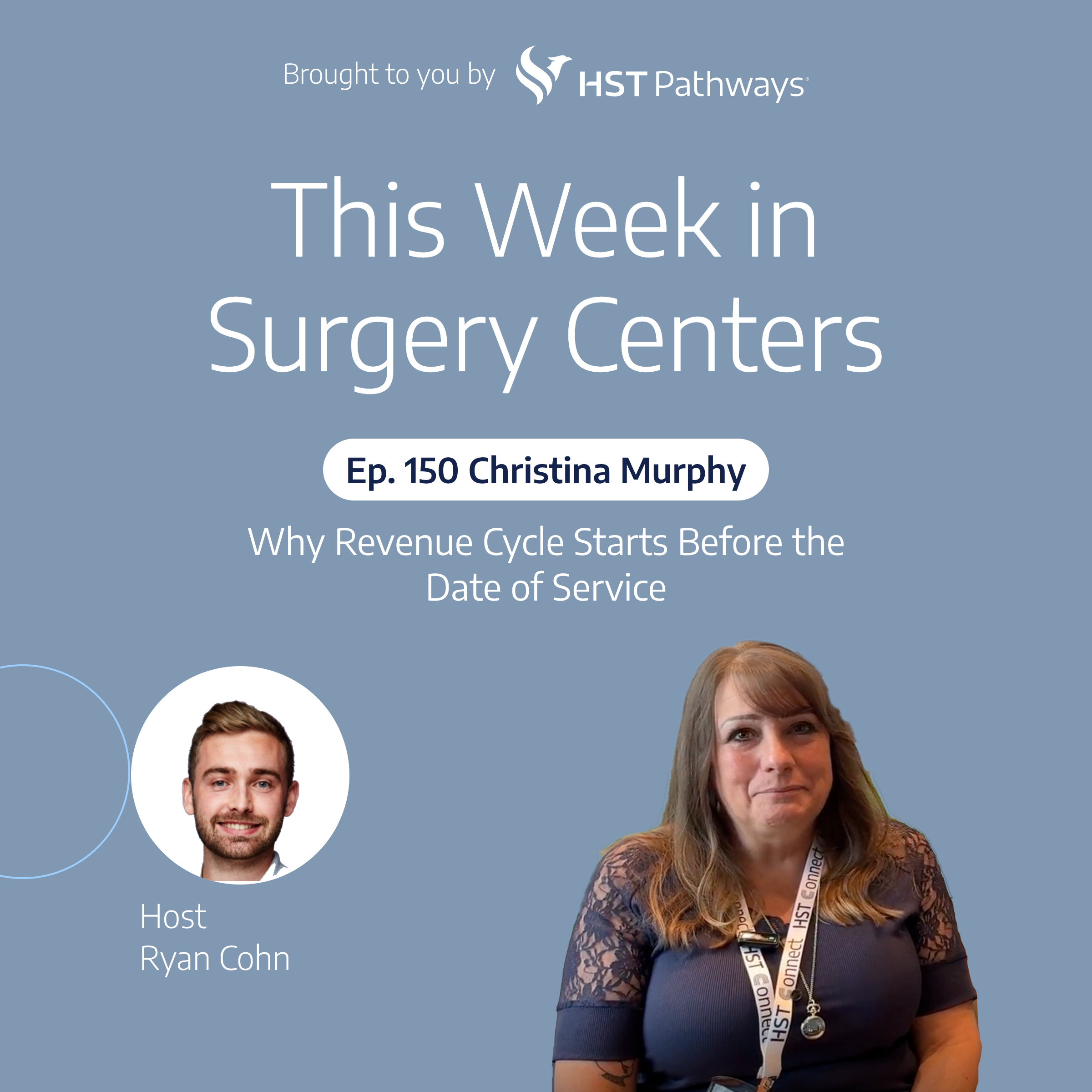


Ep. 150 Christina Murphy – Why Revenue Cycle Starts Before the Date of Service
Here’s what to expect on this week’s episode. 🎙️
Christina Murphy works in revenue cycle management at Surgery Partners, where she helps new surgery centers set up RCM workflows and technology. Christina joins us this week to break down why revenue cycle starts the moment a case is scheduled. She walks through what a center needs to build an accurate patient estimate, why early pre-service conversations matter for patients and facilities, and what revenue cycle decisions a new center should make before its first case. She also explains where automation and AI fit, from eligibility checks to prior authorization flags and op note documentation, and why human oversight still matters.
In our news segment, we cover the launch of the ASC Job Board, a new study projecting a growing surgeon shortage, and an update on Leapfrog’s public ratings for surgery centers.
Resources Mentioned:
ASC Job Board – https://ascjobs.hstpathways.com/
ACS press release, US Will Face a Shortage of Nearly 28,000 Surgeons by 2038 – https://www.facs.org/media-center/press-releases/2026/us-will-face-a-shortage-of-nearly-28-000-surgeons-by-2038-first-nationwide-study-finds/
Vizient forecast of ASC volume growth (ASC Focus) – https://www.ascfocus.org/ascfocus/news/digital-debut/202607-vizient-forcasts-continued-growth-in-asc-volume
Leapfrog press release, ratings for record numbers of hospitals and ASCs – https://www.leapfroggroup.org/news-events/leapfrog-group-publishes-ratings-all-time-record-number-us-hospitals-and-ambulatory
Leapfrog ASC Public Reporting Program – https://www.leapfroggroup.org/asc-program/welcome-asc-public-reporting-program
Brought to you by HST Pathways.
Episode Transcript
Ryan Cohn: [00:00:00] Welcome to This Week in Surgery Centers. If you’re in the ASC industry, then you’re in the right place. Every week, we’ll start the episode off by sharing an interesting conversation we had with our featured guest, and then we’ll close the episode by recapping the latest news impacting surgery centers.
We’re excited to share with you what we have, so let’s get started and see what the industry’s been up to.
Hey everyone, here’s what you can expect on today’s episode. Christina Murphy has spent about 35 years in healthcare, moving from clinical work into administration and now revenue cycle at Surgery Partners, where she helps new centers set up RCM workflows and technology. She joins us to talk about why revenue cycle starts the moment a case is scheduled.
She breaks down what a center needs for an accurate patient estimate, why early pre-service conversations matter, and how a small front-end fix can cut back-end denials. We also get into [00:01:00] where automation and AI fit in all this. Then stay with us for this week’s news segment.
We’ll share a brand-new resource we just launched for surgery center hiring. We’ll look at a new study projecting a growing surgeon shortage with ophthalmology and vascular among the biggest gaps, and see what Leapfrog’s now live public ratings mean for your center
I hope everyone enjoys the episode, and here’s what’s going on this week in surgery centers
Christina Murphy: so I’ve been in the healthcare field for about 35 years.
I started in a clinical space and worked all the way through being in clinical to moving over to administration and now focusing more on revenue cycle management and integrating those workflows and software. And that’s primarily what I do for Surgery Partners. We work with new centers coming in and how we implement RCM [00:02:00] applications and workflows to give the best practice standard.
Ryan Cohn: I know we, we spoke about this in a, a previous conversation, but you said that revenue cycle begins as soon as a patient is scheduled what should ASC leaders understand about everything that needs to happen before the date of service?
Christina Murphy: So, I mean, when you think about revenue cycle, w- it really does start with the scheduling point.
If you’re receiving information from your provider’s office, you’re basing how your billing is gonna go based on that information. So, for example what procedure the patient’s having. Each procedure has a, a cost in that in payor contracts, which a reimbursement’s gonna be. Patient demographic information.
Having that information ensures that you’re billing the right insurance company. So you’re billing when correct and clean claims are going out the door, your revenue comes in steadily for your facility.
Ryan Cohn: Yeah.
Christina Murphy: So the importance of having that information from the start really does [00:03:00] ensure a smooth transition from clinical to the billing and reimbursement.
Ryan Cohn: Yeah.
Christina Murphy: If that makes sense.
Ryan Cohn: Yeah. Absolutely. I mean, that’s, I think it’s important to think about revenue as, being the entire life cycle- Mm-hmm … of a case, and you need to be able to plan ahead and and give patients the, the proper, expectations and- Mm-hmm … and everything that goes along with that.
So why why is accurate charge capture so important to the financial health of a surgery center?
Christina Murphy: Well, i- if you think about, Look, each facility, they are a business as well. We’re here to give care to patients, but also need to have a positive reimbursement for work done in order to be able to keep performing the service.
So it’s important to have that front-end charge capture by having correct information, again demographic information, insurance information, case information. It gives stability to clinical outcomes. It also gives stability to billing outcomes and reimbursement, [00:04:00] which ultimately is a patient satisfier.
Mm-hmm. The last thing they want– a patient wants to do is have a procedure and then have a nightmare of a billing experience that kind of sours that recovery. So the importance of having all of that information correct and again, making sure that you have all the basic charges or coding done for service, services performed ensures that you’re getting reimbursement appropriately for the efforts put in by surgeons and the facility to cover costs.
Also, to ensure that in the end, once you have sent a claim out to the insurance company and your reimbursement comes in, that whatever may be a balance bill to the patient is fair and correct.
Ryan Cohn: Yeah. Yeah. That makes sense. What are some things that you and your team have done to make sure that- those bills are correct and that you are prepping, patients and
Christina Murphy: I think the importance to focus on that we have really done a lot of education with facilities is pre-services.
That’s a, [00:05:00] a, a word you’ll hear a lot about. Pre-services is really meeting the No Surprises Billing Act and also really having a, a good dialogue and open transparency with your patients and your provider offices to understand what is going to be the cost. We tend to use our application, so using revenue cycle-focused software to make the scheduling process more streamlined all the way up to creating patient estimates so that we have an understanding, both patient and facility, what patient’s coverage is, they have active coverage, what’s gonna be out-of-pocket for patients- and having those crucial conversations with patients to give them the opportunity to make informed and educated decisions-
Ryan Cohn: Yeah. Yeah …
Christina Murphy: both clinically and financially.
Ryan Cohn: Yeah. That makes sense. And I know we’ve talked about it, off camera here, but, It’s– it sounds like you guys have really made an emphasis with your centers to have those, those conversations often and early [00:06:00] and and be able to give them other options, if they aren’t able to make it happen, if they aren’t able to pay their bill or if they need to postpone it.
So, yeah, I guess what are some of your recommendations around that? What could other ASC leaders do, and what are some policies maybe that they could implement around this? Sure.
Christina Murphy: I think for any ASC leader, it– really look at your workflows of how cases are coming in. And look at how that information you’re receiving, how often is it truly correct?
Are you seeing a lot of cases being scheduled but it has wrong insurance or wrong information? Look at your pre-service processes. Are you creating a correct estimate to give to your patient? Are you receiving correct case information, meaning what kind of procedure is being booked?
Making sure you have all that correct information. If you do it from the front end and from the very beginning, the workflow on the back end will really be a lot easier. You may have some upfront work to do [00:07:00] in getting the case scheduled but the back end of billing and patient conversations about collections on bills really will be a lot less of a lift.
Ryan Cohn: Mm-hmm.
Christina Murphy: Having those crucial conversations with patients really does open up a positive dialogue to really allow a patient to make an informed decision. “Is this something I, I wanna do right now?”
Ryan Cohn: Mm-hmm.
Christina Murphy: No surgery center will ever say, “Oh, you can’t have this service if you don’t pay.” But what I’ve heard a lot in the years that I’ve been doing this is patients would rather know upfront- so that if there’s more time they need to make arrangements to cover cost, they have that opportunity to make that decision.
Ryan Cohn: So, obviously it’s so important for, for patients to, get their bills up front and, or know what they’re expecting to pay and have those conversations, and I think it’s really important, the work that you and your centers are doing.
So what information does a center need in order to provide an [00:08:00] estimate to their patients?
Christina Murphy: So first off, what’s the patient’s insurance? Mm-hmm. Second, what, what case or what procedure are they having? Those two pieces of information are the most important. You need to know what services are being performed.
Ryan Cohn: Mm-hmm.
Christina Murphy: And secondly, what’s their insurance company? Those two pieces of information will allow any facility, any surgery center to be able to run eligibility and benefits for the patient’s insurance and compare those benefits to the procedure being performed. And by having that insurance information you can compare that procedure, those benefits, against your contracted rates with your reimbursement rates with your insurance company.
And that way it can triangulate or calculate a patient’s estimate of what will most likely be out-of-pocket or patient responsibility.
Ryan Cohn: Interesting. And that brings up another interesting question for me, which is, bef- I know you have tools that- Mm-hmm … that probably automate that now, but Before that, was that, a lot of that just done [00:09:00] manually and- Yes.
Oh my gosh.
Christina Murphy: Yes. So early on in my career when I made the shift from being clinical to going more administrative I did surgery scheduling for about 15 doctor practice. And we would basically have to s- not only schedule the case from a scheduling, get it on the actual schedule, but then taking that case information and comparing it to the patient’s insurance company.
We’d have to log into payor portals, pull that information, put in the the procedure codes then run the patient’s benefits, and then break out your calculator and estimate the patient’s out-of-pocket cost.
Ryan Cohn: Oh my gosh.
Christina Murphy: That was a very time-consuming manual process. Now today everyone is very lucky that now a lot of that is automated.
Oh, if only we could have some of the programs back in the day that that we have now, my life would’ve been so much easier then. Yeah. But yes, automation, especially AI coming in is really gonna [00:10:00] be take that to the next level. But these systems can automate that in instantaneously. Yeah.
Whereas it would take, a good amount of time to manually do that and calculate, which leads to possibility- … of human error. So that’s one benefit of having AI and computer-generated automation, is there’s a lot less human error.
Ryan Cohn: Yeah.
Christina Murphy: And just needing more human oversight.
Ryan Cohn: Yeah. Which I think is a great segue to what you and I talked about earlier, but, like that, that’s one great example of how technology came in and was able to make your life so much easier and make everyone’s life so much easier. Mm-hmm. So what would you say to those, those people or ASC leaders that are out there and they may be hesitant to adopt some of these new tools and adopt technology into their centers to- Sure
to make their lives and processes better?
Christina Murphy: I think the biggest fear comes from letting go.
Ryan Cohn: Mm-hmm.
Christina Murphy: You have a workflow, you know it’s working or you feel it’s working for your center, and then the [00:11:00] thought of taking all that away and putting that that control in the hands of a computer, it can be scary.
What happens if the computer, doesn’t do what it’s supposed to do or breaks down? Mm-hmm. I think don’t be afraid to use tech or use modern features and applications to streamline and ease some of those manual processes. You still as human oversight will always be able to look and monitor to make sure things are correct.
Y- your staff or the time needed by manual processes will go away and allow you to take that time and do it- … use it for more patient-centered care.
Ryan Cohn: Yeah.
Christina Murphy: So rather than spending countless hours manually calculating estimates or manually running eligibility and benefit information, for example using these features that are available, this tech out there that’s available, software applications really can be a game changer.
[00:12:00] So I think overall embrace.
Ryan Cohn: Yeah.
Christina Murphy: Embrace it. You’d be pleasantly surprised at how easy it is to implement, use, and you’ll find that you’ll have at- that extra time to focus your staff on doing other things.
Ryan Cohn: Yeah. And, and it’s only gonna continue to get better-
Christina Murphy: especially when, with AI coming and more automation that way. I think it’s gonna be very interesting to see the next five years in healthcare w- for revenue cycle, what that’s gonna be like.
Ryan Cohn: I’m excited for it. Yeah. Me too. Me too. It’s, I think AI is is pretty underutilized in the healthcare sector, and there’s, obviously w- there’s security and regulation- Sure
and things that need to be well-respected, but there’s a lot of room for opportunity and improvement- Absolutely … and making your guys’ lives easier. So I’m excited for that. I want to go back to, you and your centers and wanted to ask about when you’re opening a de novo ASC, what are some of the revenue cycle processes and technology decisions that need to be made [00:13:00] and before even the first patient walks through the door?
Christina Murphy: Fair question. I think it, it’s a multi-stakeholder decisions and questions and information sharing that needs to happen. Understanding the facility’s expectation of what they expect the revenue cycle process to look like. And then from our team sharing what what is expected from the company or expected in general as best practices what does that landscape look like so that everybody understands what the process is, what the needs are, and then can build those workflows to make decisions about what kind of software you’re going to use.
Yeah. Do you need this or do you need that? Are you gonna be accepting these types of cases or insurance? Does that make a difference in the application or s- or tech that you use? What kind of fi- financial plans or what kind of collection conversations do you wanna have with patients? Do you as a facility offer- pay plans or different things like that. What is, [00:14:00] I think, a, a really solid conversation with all stakeholders so that everyone has a chance to discuss what is needed, what’s expected, and what is going to work for that particular facility. I think those are the first conversations to be had, and from there, decisions are made and implementation can happen accordingly- based off of those decisions and conversations.
Ryan Cohn: Yeah. That makes sense. And what do you th- what are some integrations that are most important when building a revenue cycle workflow for a new surgery center?
Christina Murphy: The most important, I think, would be understanding how you’re going to schedule your cases.
So for example are you as a facility going to receive the information and schedule or are you gonna use a shared scheduling model? And then putting down some best practice rules in a sense of what information is needed- … from a revenue cycle standpoint, not just from a clinical standpoint, but revenue cycle standpoint.
You’re going to need your full insurance information, copies [00:15:00] of cards. Please copies of front and back of insurance cards makes a huge difference.
Ryan Cohn: Yeah.
Christina Murphy: Not just the information in a text form. Making sure that you’re having those conversations with provider offices having to have them understand what information you need in full to make sure that you have a successful case scheduling for clinical and revenue cycle outcomes.
Ryan Cohn: I guess to go back on our AI question a little bit how are AI-enabled tools being used for areas such as insurance verification and prior auth-authorization checks and payment posting and so on and so forth?
Christina Murphy: So when you come with, When you think about benefit– eligibility and benefit verification it used to be that you’d have to log into a portal, punch in a CPT code that’s a code for your procedure diagnosis code, patient’s insurance information, and then, click run it, and it would look at the payor’s policies and guidelines and tell you, okay, this is a covered [00:16:00] benefit and here’s what’s, gonna be covered and whether or not you need a pre-authorization.
Mm-hmm. Very manual process.
Ryan Cohn: Mm-hmm.
Christina Murphy: Now with automation, it’s done instantaneously. You have applications out there such as Clarity- Mm-hmm … that will take the CPT code of the case that’s scheduled the patient’s insurance information, the contract information that’s been your payor contract with that facility, and instantaneously calculates eligibility, what benefits, compares those benefits to the procedure being done and the contract rates that have been negotiated for your facility- and can instantaneously produce an estimate of patient responsibility- … and what insurance responsibility would be- … for reimbursement.
Ryan Cohn: I see. And are you using any tools like Claude or like ChatGPT or are you or are your centers or surgery partners implementing that or using Claude Code to build any custom dashboards or anything like that?
I’m just curious.
Christina Murphy: From our team revenue cycle I would [00:17:00] say yes. Specific uses, I think that really depends on the teams that are using- Yeah. I can tell you personally, ChatGPT is a great way to refine complex emails or complex training materials. So we do use that to make sure that we’re being more concise in our training materials when we’re educating facilities on how to use these applications or features in the applications or talking about pre-service processes or any workflows.
Ryan Cohn: Yeah.
Christina Murphy: It may make sense to me But I have an advantage of so many years of doing that. I need to make sure that when we’re relaying that information to people that are new to using these features or new to changing their workflows, that we’re- … being concise. So personally, ChatGPT is a go-to for me.
Ryan Cohn: Yeah.
Christina Murphy: I, I honestly, for other teams, I can’t imagine that they’re not using things like that.
Ryan Cohn: Yeah …
Christina Murphy: but I don’t wanna speak for them.
Ryan Cohn: That makes sense. That makes sense. Yeah, I mean, it’s it’s such a powerful tool, and I think it can be overwhelming trying to figure [00:18:00] out all of its different use cases.
Mm-hmm. But, you know-
Christina Murphy: We’re still in the early stages of learning all that it can do, but-
Ryan Cohn: Yeah …
Christina Murphy: I’m so looking forward to the next five years to see what happens with that.
Ryan Cohn: Yeah. Yeah, and I th- I think you that’s a great use case is Creating documentation for I would assume probably for your fellow employees- Mm-hmm
but also for your centers and-
Christina Murphy: Sure …
Ryan Cohn: you know-
Christina Murphy: Educational material internal material for your- Yeah … teams. And I think even there’s some application or there’s some use for op note documentation. Mm-hmm. One of the biggest things that can contribute to questions of medical necessity or denials is lack of documentation.
Ryan Cohn: Mm-hmm.
Christina Murphy: Mm-hmm. Insurance companies, really do rely on what’s documented in an op note, and you wanna ensure reimbursement at the highest rate or a charge capture at the highest possibility or highest level. Mm-hmm. Documentation needs to be concise and to back up and justify- … the charges that you’re submitting to an insurance company, and rightfully so.
If the work’s [00:19:00] been put in, you should be reimbursed for the work that has been performed.
Ryan Cohn: And that’s… Are you talking about when they… the insurance company audits a case, basically?
Christina Murphy: Mm-hmm. Not just auditing, but a lot of insurance companies will look at it to… They’ll receive a claim and say, “Okay, well, I see this procedure’s done.
Here’s the op note to justify charging, justify using or billing that particular type of procedure.”
Ryan Cohn: I
Christina Murphy: see. If it’s not documented correctly, you run the risk of underpayment or no payment, denial. And then from there it’s chasing, chasing down information from the insurance company resubmitting claims, and it just drags out that process and ultimately drags out patients being able to receive a bill and to, if there is any reimbursement or, excuse me, any out-of-pocket responsibility afterwards if they should receive a bill it just drags that out so that they can’t just close that and complete that- portion of that, of their care and the services they’ve received.
Ryan Cohn: I see. And would you say technology has helped with those [00:20:00] reimbursements and- Absolutely … and helped with denials and things like that?
Christina Murphy: Absolutely. You can track your denials. You can find trends a lot easier. You had asked about automation and, I mentioned about auto eligibility and benefit verification, but also pre-op.
Mm-hmm. We have a system of CPT codes where one code could say, “No, we don’t need pre-authorization,” but during the procedure or, something comes up in the case during the surgery that has now changed that initial procedure code, and now you do need a pre-authorization. Mm-hmm. So the importance of having the poss- you know, not only just the case you’re going to book, but the possibility the case could change if known, if the provider knows it to maybe give a heads up, could be, could turn into this, could be having these added codes.
But automation can detect and kind of give that feedback to the facility that yes, you might not require an authorization for this procedure, but for these procedures, which could be the next level up, … I might be doing just a, a [00:21:00] colonoscopy, but that colonoscopy could end up needing a biopsy.
That bi- that colonoscopy with a biopsy code could require a pre-authorization. So if you apply AI to it or automation to that, that could be a game changer to let you know, yeah, you might not need a prior authorization for this particular procedure, but be wary or be aware that you’re going to need one for this.
So the uses of that technology or that those features can really be a game changer to prevent denials later on. And not just finding trends and looking at ways you can look at your denials and say, “Okay, we have a problem here,” and make a front-end change that- Yeah … will resolve the back-end denial rate.
Ryan Cohn: Yeah. Yeah, that makes sense. And since we’re kind of talking about AI already I know you’ve heard about AI being kind of a worry for your employees, and people are obviously worried about AI coming for their jobs. Sure. And, the security aspects- Me too. … and, it’s something- It’s real funny
we all think about.
Christina Murphy: Mm-hmm.
Ryan Cohn: Sure. We all think about it. What are your thoughts on, [00:22:00] what would you say to those people and leaders that are worried about AI replacing them in healthcare, for example?
Christina Murphy: I would say that you will always need a human component. A computer is a computer.
Ryan Cohn: Mm-hmm.
Christina Murphy: It’s only as good as the information that it’s fed. You can set up code and run automation, but it’s only as good as how that’s built. There will always need to be a human component to oversee and overwatch basically to make sure that that automation or that computerized feature or application is running correctly, that there doesn’t need to be a change and a rewrite into code.
So you will always need a human component. Computers can’t totally replace people. Mm-hmm. Will I say that it will never cost somebody their job? I don’t know if that’s true or not true. What I can say is that I don’t see that being a a replacement- Mm-hmm … completely. Will you need as many staff members to do manual, you have manual processes, you need three people to do that.
You automate it, would you need those same three people to do that same job? No. Maybe [00:23:00] job duties will change, or you’d be able to take your sta- your staff and rightsize it and put them in areas- … to do more patient-centered care- … versus being stuck doing a manual process and not being able to have that patient first- interactions or direct patient care.
Ryan Cohn: Interesting. Yeah, so it almost… it frees up frees up bandwidth for people- Mm-hmm … or for you to hire, people that, that can take better care of your patients or have the a- availability to take better care of your patients. Absolutely. So that’s- Absolutely
that’s really interesting. It just takes away from being behind a computer all day- Mm-hmm … which some people love, some people hate it. That’s
Christina Murphy: right. And it’s… I don’t know. We’ve all been in a doctor’s office where the poor doctor is trying to document on the electronic medical record typing away, but they’re not looking at you.
Mm-hmm. And you’re not sure if they’re really hearing you. Well, that goes true for any any, any medical practice or a facility. If you’re stuck behind a computer, you’re not really truly 100% focused on [00:24:00] your patient.
Ryan Cohn: Yeah.
Christina Murphy: And patients see that, and that can lead to errors. That can lead to a disconnect in building that patient-provider bond or that patient-facility bond.
And that’s really what we as healthcare professionals want to provide is instill trust and relationships with your patients so that they’re getting the best care possible.
Ryan Cohn: Yeah. Yeah. Well, well said. And thank you so much for coming on. It’s-
Christina Murphy: Thank you for having
Ryan Cohn: me … it’s been a pleasure having you on and chatting with you.
And I want to ask you one last question. We do this every week- Mm-hmm … for our guests and for our listeners. What’s one thing our listeners can do this week to improve their surgery centers?
Christina Murphy: I would say focus on your pre-service processes. Take some time to look at what your current workflows are.
Look and see what’s working and what’s not working. And then from there, make informed decisions on what is out there for applications or tech that can help automate to make your [00:25:00] workflows more efficient. Mm-hmm. To make sure that if you’re seeing trends or outcomes that are not favorable look at those front-end workflow processes to see if a small change can make a big impact on the back end.
Ryan Cohn: Awesome. Well, well said. Thank you. Thank you so much, Christina.
Christina Murphy: You’re very welcome.
Ryan Cohn: Welcome back. Let’s get into this week’s news. First, something from us. We just launched the brand-new ASC job board, a job board that was built only for ambulatory surgery, so you won’t be sorting through other types of healthcare roles. And surgery centers and ASC management organizations, other employers hiring for ASC-related roles can post directly to the job board at no cost to them.
It’s free to use, and the listings cover roles across the center from leadership and clinical care to the business office, scheduling, physicians, and anesthesia. You’ll [00:26:00] find it at ascjobs.hstpathways.com or by visiting the link in the episodes description Next, a new study on the surgeon workforce.
Researchers presented it at the American College of Surgeons Clinical Congress, and it projects a shortage of nearly twenty-eight thousand surgeons by 2038. Using a federal workforce model covering 10 surgical specialties, they found surgeon supply falling 4.2% between 2023 and 2038, while demand rises 12.8%.
That would leave the workforce meeting about 84% of the need.
The gaps vary by specialty, of course, with vascular surgery only meeting about sixty-six percent of the demand and ophthalmology about seventy-two percent. Thoracic and plastic surgery land in the low seventies, and orthopedics is at about eighty-eight percent. The shortage is also projected to hit rural areas harder.
This [00:27:00] is, of course, just a projection from a model, not a count of open positions today. But for comparison, the Vizient forecast we covered in August projects ASC procedure volume growing twenty-four percent over the next decade. Last, an update on something we mentioned back in May.
Leapfrog’s public ratings for surgery centers are now live. Leapfrog actually published its 2026 results back on July 27th, launching its ASC public reporting program with scores for about 3,900 surgery centers
Most of the scores rest only on quality data that the centers already report to CMS. About three hundred centers also submitted Leapfrog’s ASC survey, an accreditation certificate, or both. Leapfrog also added a full transparency badge for centers that complete every section of the survey, and results now update monthly, and late submissions are accepted through November thirtieth
Not everyone is sold on the [00:28:00] survey. When ASC administrators took Leapfrog’s 2019 survey, some called it too focused on hospitals, and Leapfrog has since revised it as ASC Survey 2.0, which covers patient rights, health equity, never events, and safety practices That’s it for this week’s episode of This Week in Surgery Centers.
Thanks again to Christina Murphy for joining us. I had such a wonderful time getting to know you and chat with you. And thank you to all of you for listening. If this episode was at all helpful, please share it with your colleagues at your center, send it to a friend.
It’s the best way to support the show and helps us grow. We’ll see you next week