
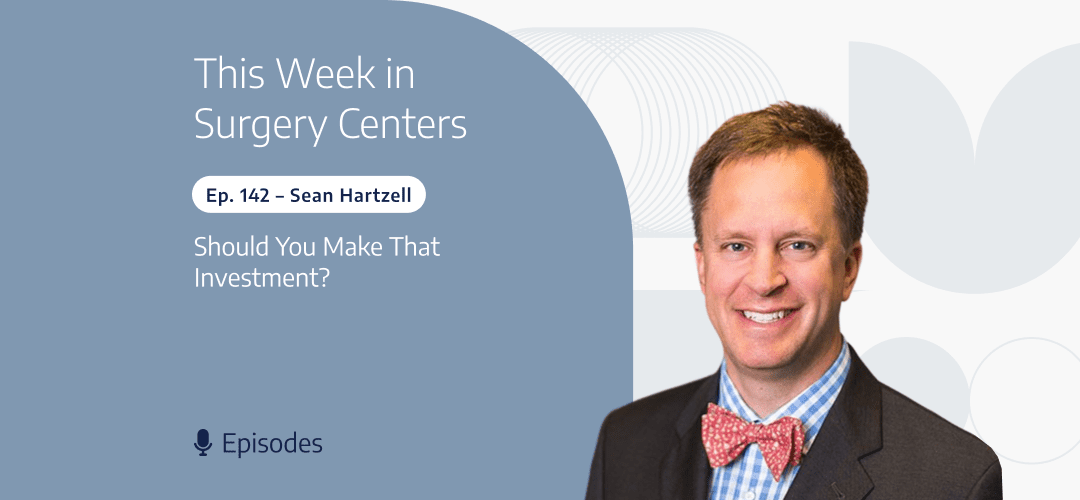
Sean Hartzell is a Managing Director at VMG Health, where he advises healthcare organizations on strategy and capital planning. Sean joins us this week to break down how ASC leaders should think about funding growth. He walks through the key differences between debt and equity, how to calculate the “true” cost of major investments beyond the upfront price, and what factors can make or break a new initiative.
In our data segment, we’re talking all about spine. Spine is being called one of the fastest-growing ASC service lines, driven by a combination of CMS policy changes, payer pressure, and continued advancements in minimally invasive techniques. We’re going to spend the episode focusing specifically on spine ASCs and the potential opportunity for growth based on data-driven insights.
Resources Mentioned:
HST’s Specialty Data Report: Spine
Brought to you by HST Pathways.
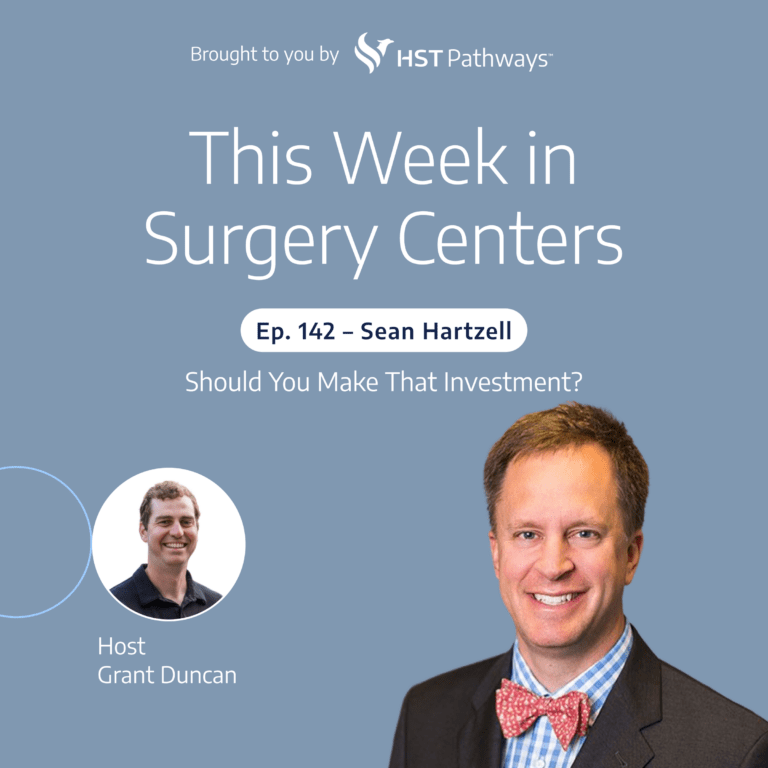



Ep. 142: Sean Hartzell – Should You Make That Investment?
Here’s what to expect on this week’s episode. 🎙️
Sean Hartzell is a Managing Director at VMG Health, where he advises healthcare organizations on strategy and capital planning. Sean joins us this week to break down how ASC leaders should think about funding growth. He walks through the key differences between debt and equity, how to calculate the “true” cost of major investments beyond the upfront price, and what factors can make or break a new initiative.
In our data segment, we’re talking all about spine. Spine is being called one of the fastest-growing ASC service lines, driven by a combination of CMS policy changes, payer pressure, and continued advancements in minimally invasive techniques. We’re going to spend the episode focusing specifically on spine ASCs and the potential opportunity for growth based on data-driven insights.
Resources Mentioned:
Brought to you by HST Pathways.
Episode Transcript
[00:00:00]
Grant Duncan: Hey everyone. Here’s what you can expect on today’s episode. Sean Hartzel is a managing director at VMG Health, where he advises healthcare organizations on strategy capital planning much more. He joins us this week to break down how a SC leaders should think about funding growth. He walks through the key differences between debt and equity, how to calculate the true cost of major investments beyond the upfront price.
And what factors can make or break a new initiative. Sean also shares how centers can prioritize competing [00:01:00] opportunities using data, and in some cases, fund growth through operational improvements instead of raising capital. After. In our data segment, we’re talking about spine. Spine is being called one of the fastest growing a SC service lines.
And it’s driven by a combination of CMS policy changes, payer pressure, and continued advancements in minimally invasive techniques. We’re gonna spend the episode focusing specifically on spine ASCs for this segment and the potential opportunity for growth based on those insights. And if your center isn’t performing spine procedures.
That’s okay. The themes that are covered in this segment will also be applicable to you. Hope you enjoy the episode, and here’s what’s going on this week in surgery centers.
[00:02:00]
Grant Duncan: Hey, Sean, it’s great to have you on the podcast today. Can you give our listeners a brief background on yourself?
Sean Hartzell: Certainly. And thanks for the invitation. Yeah. My name is Sean Hartzel. I’m a managing director with VMG Health, and I lead our ambulatory surgery specialty practice, and membership service lines.
So a mouthful, but basically I am helping to grow our ambulatory surgery growth and optimization p component to our service line that we’ll talk about a little bit more. We’ve got a group that does specialty practice management focused a lot right now in aesthetics, ophthalmology, and other cash-based elective specialties that have a heavy.
Clinic and procedural component. And then we also have some [00:03:00] membership tools focused on ambulatory surgery aesthetics, ophthalmology, those types of practices. And virtual board of director education. So I’ve got a collection of service lines at BMG.
Grant Duncan: Thanks for that overview. So, when a SC leaders start thinking about growing their A SC, sometimes that means adding specialties or expanding ORs, or potentially buying new equipment.
Before they do that, what do they need to understand about their current financial performance? Before making that investment decision, for instance, ebitda, looking at their budgets, forecasts, et cetera.
Sean Hartzell: Yeah. So, well, I think you touched on part of it. I grew up, I started. My career with a health system here in Northern Virginia focused on financial planning and analysis.
So a big component of that [00:04:00] was developing an annual operating and capital plan for the system and for each hospital. And then structuring conversations with each business unit to really understand how they’re performing versus their budget. What is, what’s causing any variances and are there any places where they can either learn from their colleagues to improve or just improve overall?
So can they put together any sort of improvement plans? And I think when I look at and think about your question, I think it’s really important to understand how you are doing from an operational and financial perspective. ‘Cause that frames. Where you need to go, right? You can either if you’re doing well, you can start to look outside and look at some external opportunities.
But if you’re not doing well, it’s really time to turn inside into the practice, into the surgery center and really say, okay, what are we doing well? What aren’t we doing well? And what can we do better? So it’s [00:05:00] it, yeah. I really think that you need to have a grounding in your financial and operational performance.
As you consider, whether it’s building a new or bringing a new service line or a new procedure in recruiting new doctors who may not be doing the same work that your doctors are doing or even any sort of large scale enhancements or additions.
Grant Duncan: Right. That makes sense. So before an A SC goes out to raise debt or equity of some sort.
How should their leaders determine whether they actually need outside capital?
Sean Hartzell: I think it’s important, and this goes back to my underpinning to get a really strong business plan. In place. And when I think about a business plan, I’m thinking about both the qualitative side, like why we should do this, and then the quantitative side, which says, how much do we have to invest? What’s the volume look like when we make that investment, and when do we think that volume’s gonna come?
[00:06:00] And what do we think the the margin is on each case, which really then says. When are we going to generate a positive cash flow to be, to pay off that investment that we made? And so, gosh, I go all the way back to Inova and some of the first work that I did in and with ambulatory surgeries as we built a monthly financial statement to understand we were building an a SC and we looked at.
The cash flow for that a SC, how much we had to put in. And when we would start getting that money back out so we could actually understand how much debt do we wanna bring in, how much equity do we wanna bring in? And if we, if we built this equity model and this debt model, what would, what would all the different components be?
Whether it’s short-term debt, long-term debt, or equity, right? So how do we move those levers around to build a, an overall, plan for that investment.
Grant Duncan: Yeah, that’s a great example. Do you [00:07:00] recall any specific conversations or decisions you made for how to think about the debt versus equity there?
Sean Hartzell: Yeah, so the conversations that we had, and it sounds it probably sounds self-serving from a VMG perspective, but we used VMG for all our, all of our valuation work.
And so, we built this financial model, this business plan, and really took it to VMG to say, put, let’s put a value on this at startup to understand from a capital perspective, how much money do we think we could raise or how much. What we could charge from a share price perspective to potential investors.
And that helped us build the equity component of our overall capital plan. And then we worked with bankers, with conversations with bankers to say, Hey, we need an extra $5 million to make this opportunity a reality. And. We’d like to, we’d like to put as [00:08:00] much of that as possible into long-term debt because here’s what the cash flows are gonna look like.
But we also know we need to have a short-term line of credit to help with that initial 90 to 120 days worth of cash flow requirements until we could actually start generating some some revenue from procedures. ’cause that’s how long it takes to get. Medicare certification and get on all of the managed care payer contracts.
So we, we worked with our bankers and we worked with our investors to really structure the overall capital profile and the liability and equity component of the balance sheet. I
Grant Duncan: appreciate that example. Very tangible for others to think about how they can apply that. So let’s say a center is also wanting to take a similar approach.
Maybe they’re expanding or they’re building new centers like you were just talking about, or maybe they [00:09:00] wanna add a robot or add a new specialty line such as cardiovascular. They’re often going to focus on that upfront cost, but how should they think about the true cost beyond just the initial price tag for let’s say, a robot or the equipment you were hitting on it with that example with Nova, but I think we can extrapolate it to how others should look at the all in cost as well.
Sean Hartzell: Yeah. So, I’ll throw out an example. We worked with a center in Southeastern Virginia recently. And they were looking at bringing a robot into into operation at their center and. Again, going back to a financial plan, we worked with them to say, the upfront cost is $200,000.
But, [00:10:00] there were a couple things, right. There was the revenue side of the equation, which is what rates are we gonna get for the procedures that are now done with a robot, and how many of those procedures can we do with the existing capacity that we have? Sometimes robot cases take longer. So, so we had to do an operational capacity assessment to build that revenue side of the equation to figure out how much revenue we could generate at I would say at full capacity from the robot perspective.
And how does that fit into the rest of the existing capacity. So that was the revenue side. The expense side was really okay. Do we need to think about, does our staff need extra training? Do we need to think about if these cases are longer or shorter? How does that affect the, our staffing ratios and our overall cost for staffing?
Does the robot or the service, I use the robot as the as the specific, but the generic, the [00:11:00] service require a different anesthesia model, and we know that anesthesia I just got back from a conference and. Every a SC administrator that I spoke to and I spoke to 2030, they all started with, well, I asked ’em the question what are the biggest issues you’re seeing right now?
And I eventually had to stop saying, I start saying outside of anesthesia, because everyone started with anesthesia. So, so you really think about what anesthesia looks like for this new new service, and then what are the other operating costs be it. Implants, other medical supplies gas, different sorts of items there to really understand what the variable cost is for each case done with a robot.
So then you can, you, then you can do the math revenue less, these expenses, everything. Hopefully that remains, contributes to overhead, which now that. Is part of, so, so, so, right. So really we’re building, again, I go back to we’re [00:12:00] building a financial plan or investment plan and a return plan for that equipment or for that service, right?
And so then that’s gonna help us understand, can we finance that investment out of our current cash flow one, which then begs the question. Do our owners want to do that? Because that could reduce their distributions in the short term, or is the better play or a different play to go out to the market and see can we get either short term or medium term debt to pay for that equipment and then, that, that may reduce the distributions over time as opposed to a big one-time hit in distributions or.
If this is a new surgeon or this new service, are there physicians who would want to invest in our center? Right? So, so it always goes back to build a plan, build out your plan, make sure that you’ve got upside, downside [00:13:00] or optimistic and pessimistic case volumes and thoughts around all the different variables that you have in there.
And then that leads to how should we finance that growth opportunity. Is it new debt? Debt or is it, bringing in new equity holders?
Grant Duncan: And when you were talking there, you talked about a lot of factors that will help you think beyond just the one specific cost element. Can you talk about how you should think about. Partners and other parties involved here. For instance, you talked about anesthesia being an issue. We all know it’s, an ongoing shortage and struggle for ASCs.
How should ASCs discuss this with their anesthesia partners? And another core constituent for many ASCs are their. Management group owners, they [00:14:00] may be minority or majority. How should they be involved in these conversations as well?
Sean Hartzell: Yeah I think engaging those parties earlier and during the planning process is important because it’s, with anesthesia. You don’t wanna get to the end game and purchase the equipment or bring in the new service and then say, oh, hey, guess what? We now have a new service that it’s gonna take you longer to do and we need specialized CRNAs. That’s a bad outcome because given the.
Current power shift with anesthesia. I think they can control a lot of what flows through an A SC. Now the nice thing is I think in a lot of ASC is at least I’ve seen anesthesia is maybe the medical director or they’re intimately involved anyways. But I think bringing them into that conversation early and under, helping them understand and getting understanding from them as well around what it’s gonna take to provide that service.[00:15:00]
Is critical because then that feeds into your financial plan from a management company perspective. And depending on whether or not you have outside management or inside management, again important to have the conversation with them early as well because, if they’re helping out with managed care contracts, they’re gonna have to work with payers to make sure that for a new service, the payers are gonna pay for that new service.
Otherwise, you’re basically giving away free care, which is. If you say, if you think ASCs are a great from a patient experience payer experience and provider and staff experience, right? You, that sort of definitely helps the top two, the payers, if they don’t have to pay for it. And the patients who get for free, they love that, but.
That’s really not always the name of the game is free care. So on hard to sustain
Grant Duncan: over time.
Sean Hartzell: Right, exactly. Yes. And going outta business sale is great. But yes, at one point in time you go outta business, it’s there is an end. [00:16:00] There is an end line there.
Grant Duncan: Yeah.
Sean Hartzell: And so, so I think working with the management company or working with your folks who help manage the center.
Yeah, it’s critical. If and a lot of times the center management will actually helping to build that business case whether it’s internal management or external management, they’re
Grant Duncan: good point.
Sean Hartzell: They be, they’re responsible for helping to build that case. Otherwise it’s a bunch of physicians and, physicians may not be the best with Excel and Word and PowerPoint and all the things you have to use to, to build that case.
So, so bring, bringing both parties in early is better than. Not bringing them early in early.
Grant Duncan: Yeah, that’s right. And many acs are gonna have multiple potential growth opportunities they could consider. Maybe that’s, like we were talking about adding a robot. Maybe it’s expanding into new specialty service lines.
ORs, et cetera. So if they have, let’s say, 3, 5, 10 different [00:17:00] options and maybe there’s some level of a business case behind each with a good ROI, how should they think about prioritizing those competing investments and being more data informed?
Sean Hartzell: Yeah, I, well, I think some of that goes back to what the overall.
Goal of the center is and, the mission of the center. Is it, to provide increasing access to care? Is it to provide, to be on kinda the leading edge of technology in, using technology in a center or something else and creating, I would say create a consistent evaluation framework.
So that you can go down and as objectively as possible, say, this is a level one, a level two, a level three, right? But good to bad or, putting the ROI next to each other, [00:18:00] putting the additional number of cases and the capacity you used next to each other. What are some of the additional costs?
What’s the payback time? So, so it’s I would look at this framework as combining qualitative and quantitative components and matching that up against the vision of the center and the overall growth plan of the center. And then making the determination as far as which ones do we wanna prioritize now, because when I think about making a strategic bet, you are.
You are taking a limited amount of resources, usually capital and time, and saying, what are the two or three things I’m gonna do that’s gonna help me get, either get more capital and more time? Right? And so framing it in a certain way that you can compare the three or four opportunities consistently and as objectively as possible is critical.
Grant Duncan: Yeah, I like how you are tying in the [00:19:00] values of the center as well because if you line up those few and ROI is maybe we all looking good. Maybe the payback periods are similar. But then one hits on the value of some center. Maybe they are really caring about patient care. Well, maybe they’re gonna choose that, even if it’s a slightly lower ROI return because it’s matching their values in a stronger way.
So I appreciate you tying that in there.
Sean Hartzell: Yeah I think that’s, I think it’s critical to, to look at that. And I think it’s also critical because when you were talking, I was also thinking. One of the, one of the values or maybe the mission of the center is to provide, let’s say it’s comprehensive orthopedic care to the community, right?
Or musculoskeletal care. Right? And so that, that points you with one direction that says, oh, this is a foot and ankle procedure. Okay, we should look at that as opposed to this is a GI [00:20:00] procedure. Well, GI may not fit in that center even though. It may be somewhat accretive or as accretive as the, or maybe slightly more accretive than the foot and ankle, but you need to weigh what the center’s doing and whether or not by bringing these different procedures or services in, are you fundamentally changing the mission of the center?
Grant Duncan: Yeah, completely. So you’ve talked about how sometimes you can evaluate your current operations and see that, hey, if we can improve our operational performance by X percent, maybe we don’t need to fund the growth throughout outside capital. Can you share an example of how you’ve seen a center use operational improvements to fund growth rather than outside capital?
Sean Hartzell: Yeah, I know. We gosh we have done numerous [00:21:00] operational assessments in the past few years that have led to organizational transformations or turnarounds. We’re working with a center right now that was generating five, 10, maybe 12%. EBITDA returns for its shareholders. And in doing a comprehensive operational assessments where we went through everything that’s going on in the center, we were able to find an additional, I believe it was two to $3 million in ebitda.
And although they weren’t, they didn’t necessarily have a series of capital investment opportunities. Before, as we’re going through this and we’re finding this and helping the organization implement the initiatives to really actualize that two to $3 million, that sort of changes the trajectory of the [00:22:00] center and now says, well, yeah we now can we now actually, we don’t have to live out of our retainer or our line of credit anymore.
We can start to build. Our day’s cash and provide healthy distributions so that now we’re, our owners are happier and we now have the internal capital and the internal flexibility to add new services and add new equipment where we don’t have to go outside, right? We’re in a stronger and we’re also in a stronger position, right?
Because the worst time to go to a bank or a, a lending agency is like when you need the money. Right. It’s right. It’s like going to the scalpers going to the the ticket office and then walking back to the scalpers to get the ticket. Like, that’s never a good sign.
But now, when you’re in a strong position from a capital perspective, banks are more willing to loan you that money at a slightly lower rate because you’re not as much of a risk. Right. The risk return for them is a different pro, a different profile.
Grant Duncan: Yeah, certainly. [00:23:00] Well, this has been great Sean.
We do this every week with our guests. What is one thing our listeners can do this week to improve their surgery centers?
Sean Hartzell: Yeah, again, it’s probably self-serving, but I think it’s really important that you assess your operations and I would say bring in someone from the outside to assess your operations as you are looking at any sort of investment.
Opportunity. So it’s and it’s I’ll say it’s I’ll go with one A and one B, even though they’re two, two different things, right? There’s one, which is get an operational assessment to understand what you’re doing well and what you can do better. But then two, if you don’t have a consistent framework for a business plan for new services, new products, new equipment, I think start to build that out so that you can compare.
Different investment opportunities and review how you did against what you thought you were gonna do so you can improve going [00:24:00] forward. So I think it’s really two things if you’re not doing those already.
Grant Duncan: Great advice. Thanks so much, Sean.
Sean Hartzell: Ah, thank you so much. This was great. Thanks Matt.
Grant Duncan: All right, so now I’m gonna talk about what’s going on in the world of spine surgery and what the opportunity is for ASCs. As you’re all familiar with by now, CMS has expanded the A SC covered procedure list in a big way for 2026, and if you zoom in on where the volume of those new procedures landed, spine and musculoskeletal are two that really stand out there, two procedures that ASCA and other lobbyists.
Are most excited about are posterior lumbar interbody fusion 2 2 6 3 0, and [00:25:00] combined posterior lumbar and posterior lumbar interbody fusion 2 2 6 3 3. But there are many others in addition to those two. Now that the rule is final and we know what’s coming. It’s good to be thinking about what to do with that.
So before jumping into any action items, let’s look at the financial possibilities. We analyzed at HST 131,000 plus spine cases across 300 surgery centers, and what we found is most spine ASCs are sitting on a massive untapped opportunity.
The average spine A SC is only using 23% of their or block time using an analogy we’ve used in the past. Imagine being on a plane and only one in four seats are booked. Imagine how much money that [00:26:00] airline is not capitalizing on. The same goes in the a SC setting. The good news is we also found the average net revenue per spine case is about 6,255, which is excellent compared to other specialties.
Now imagine a world where you increase your OR utilization for a spine cases from 23% to 50%. Which that’s still below the recommended or utilization. But even just doing that could be, let’s say, having an a couple additional cases per day that would result in over $3 million in additional annual revenue per or, and that’s the opportunity sitting inside your current schedule.
Now, of course it’s easier said than done to improve our utilization. So let’s look at some other data points [00:27:00] for spine centers from 2023 to 2024. Case volume declined from 65 to 60 cases on average per month for spine cases cancellation rates are still around 22%. And specifically insurance related cancellations are 9%, which is more than double the industry averages.
Now, hopefully with these covered procedure list changes, that number should naturally start to improve. Now, we all know spine cases are complex. They’re also typically longer procedures. Prior auth may be more difficult and patient stress can also be higher, but even with those potential challenges, growth is still possible, and it’s possible even if you don’t have spine as one of your specialties right now.
[00:28:00] But let’s say that you do have it as a specialty. Here are three areas that I’d focus on and you could extrapolate these to other specialties as well. One, fill existing block time. Try to speak with your surgeons. How can they maximize their time? Where’s the friction? How can you remove it? What procedures can they move from the hospital to the A SC given these CMS changes?
Two, eliminate preventable cancellations. Focus on patient education. Automated reminders via text. Verify insurance more than once through automatic insurance verification tools. Give patients clear financial expectations early. And then third, tighten your revenue cycle process from 2023 to 2024. Days to bill post date of service improved [00:29:00] from 10 to eight days, 20% improvement.
However, denial rates rose from nine to 10%, so I’d encourage you to really look at every step of your process and try to spend one quarter improving one area, and then repeat into the next. And if you can find some operational gaps and take advantage of CMS expanding spine procedures, you’ll be able to capture millions.
It’s really worth evaluating even if you don’t have this specialty right now. All right. That wraps up our podcast this week. Thanks as always, for spending a few minutes with us. Would love it if you subscribe, leave a review, and most of all, if you could share this with someone you know, sharing is a great way to show others that you’re thinking about them.
Have a great day.
[00:30:00]