
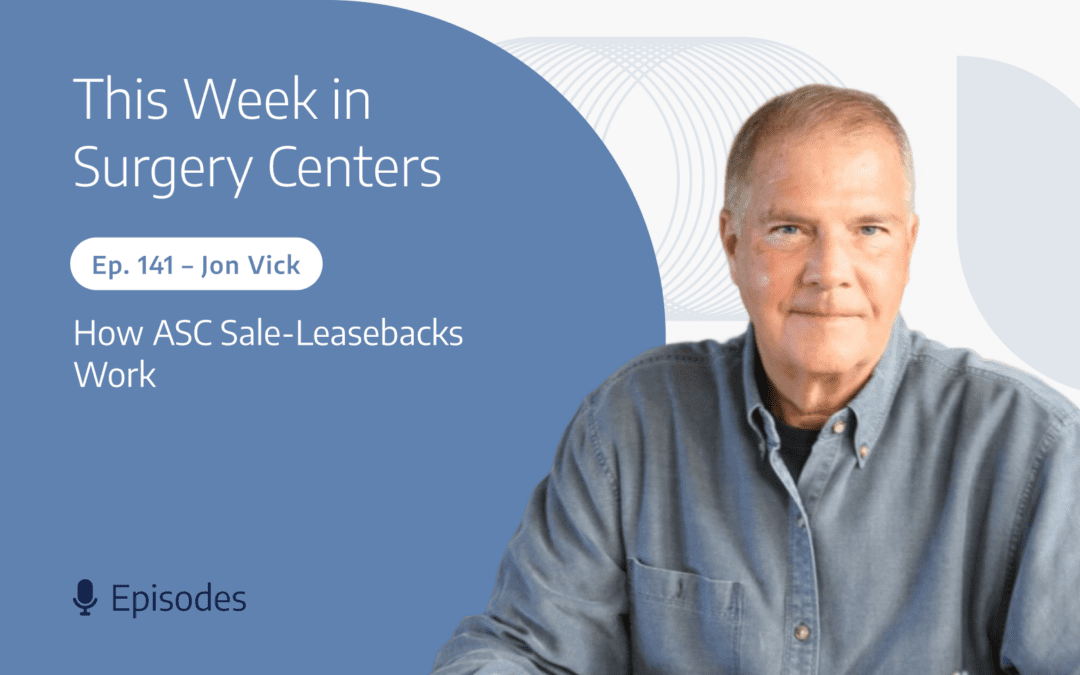
Jon Vick is the Founder and Principal of ASC Realty Advisors, where he has spent decades advising physicians and ASC operators on healthcare real estate strategy. Jon joins us this week to explain how ASC sale-leasebacks work and why they are becoming an increasingly relevant strategy for physician owners. He walks through how centers can use sale-leasebacks to fund de novo projects, expansions, and renovations without taking on additional debt, while also addressing common concerns around control and long-term value.
In our data segment, we’re discussing OR block utilization and showing how increased usage can generate millions in revenue. We’ll use real podiatry stats as an example, but the same concept and tips apply to any specialty.
Resources Mentioned: https://www.hstpathways.com/specialty-data/podiatry
Contact Jon + his team: https://www.ascrealtyadvisors.com/about/leadership/
Brought to you by HST Pathways.
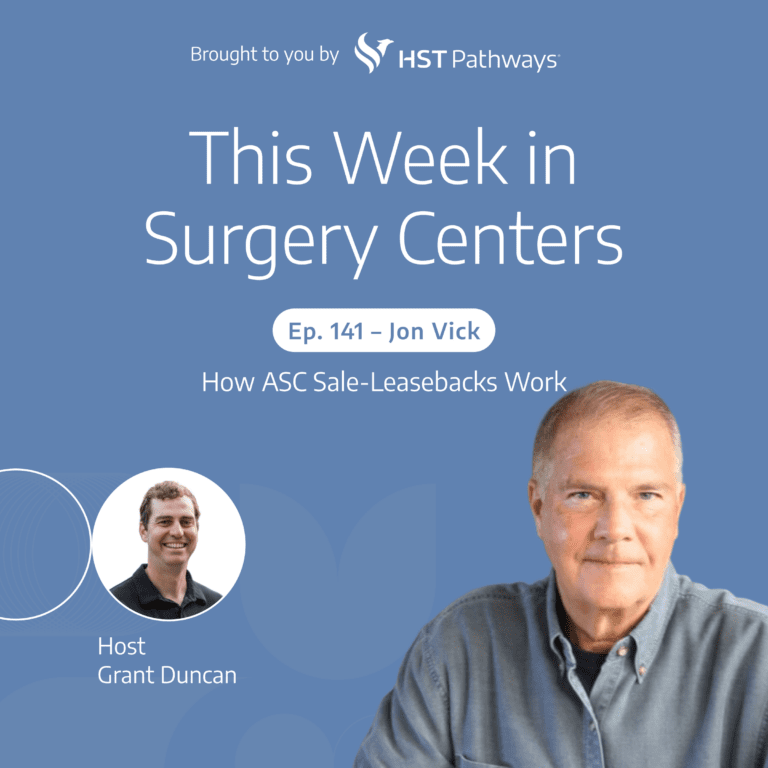



Ep. 141: Jon Vick – How ASC Sale-Leasebacks Work
Here’s what to expect on this week’s episode. 🎙️
Jon Vick is the Founder and Principal of ASC Realty Advisors, where he has spent decades advising physicians and ASC operators on healthcare real estate strategy. Jon joins us this week to explain how ASC sale-leasebacks work and why they are becoming an increasingly relevant strategy for physician owners. He walks through how centers can use sale-leasebacks to fund de novo projects, expansions, and renovations without taking on additional debt, while also addressing common concerns around control and long-term value.
In our data segment, we’re discussing OR block utilization and showing how increased usage can generate millions in revenue. We’ll use real podiatry stats as an example, but the same concept and tips apply to any specialty.
Resources Mentioned: https://www.hstpathways.com/specialty-data/podiatry
Contact Jon + his team: https://www.ascrealtyadvisors.com/about/leadership/
Brought to you by HST Pathways.
Episode Transcript
[00:00:00]
Grant Duncan: Hey everyone. Here’s what you can expect. On today’s episode, I speak with John Vick, the founder and principal of a SC Realty Advisors. Where he spent decades in the A SC industry and more recently focused on real estate strategy for ASCs, we focused on the A SC sale leaseback, how it works, and why they’re becoming increasingly popular.
He’s gonna walk us through how centers can use a sale leaseback to fund de novo projects, expansions, renovations, or whatnot without taking on [00:01:00] additional debt. We’ll talk through typical concerns and addressed how this can help an A SC grow and how it can help physician owners as well. After, in our data segment we’ll talk about or block utilization, and I’ll talk about how an increase in the OR block utilization can actually drive millions in additional revenue.
I’ll talk through. Podiatry as the example with real stats from podiatry acs. But the same concepts and tips can be used with any kind of specialty. I hope everyone enjoys the episode and here’s what’s going on this week in surgery centers.
Grant Duncan: Hey, John, I’m excited to have you on the podcast today to help people understand your background. Can you give a brief [00:02:00] description about yourself?
Jon Vick: Sure. I spent my entire career in healthcare initially working for Bausch and LA and American Medical Optics, and then in 1982 when Medicare approved facility fees for a certain.
Surgery center procedures. I started a company called Surgery Center Development Corporation, and at that time there were less than 300 surgery centers in the country. Now there were over 6,000. So it’s been a long career of advising physicians on developing centers operating them mergers and acquisitions and real estate.
The the first company I formed was Surgery Center Development Corporation, and we developed surgery centers mostly for ophthalmologists across the country. The second company I started was endoscopy center affiliates, which we formed when colonoscopies were approved for facility fees and we developed dozens of GI endoscopy centers.
The next company I formed [00:03:00] was Physicians ASCs, Inc. In 1998 when consolidation became a big factor in the industry and we advised physician owners of surgery centers. On how to partner and get the best value and the best partner with strategic partners. And most recently, I formed a company called a SC Real Estate Advisors in 2023 to advise physician owners of a SC real estate and how to get the best value out of the real estate, as well as to add to the value of the underlying a SC business.
Grant Duncan: Thanks for that overview. You obviously have a wealth of knowledge in this industry. Today we’re gonna be focusing in on the sale lease back agreement and what that can mean for ASCs for those who aren’t familiar with it, can you walk us through what a sale leaseback is and how it works specifically in the a SC world?
Jon Vick: Yeah, sure. A sale leaseback is when. [00:04:00] Physician owners of a SC real estate sell the real estate to a passive investor, receive cash for the value of their real estate. And sign a triple net long-term lease that gives the docks control over the facility as long as the lease is intact and allows them to operate just as they did before.
They just now, instead of owning the real estate, they have the cash from the sale to deploy in various ways. The cash allows the sellers to pay off debt and improve liquidity. Simplify ownership and remove per personal guarantees, and they can reset rent to increase the ebitda, which increases the value of the center.
Right now the real estate is selling at a multiple of 14 to 17 times rent, which is higher than the strategic operations which sell for a multiple of six to nine times ebitda. So [00:05:00] the real estate represents significant value that can be used to improve the business or diversify their investments into investments that have higher returns.
Grant Duncan: That’s great overview. Appreciate that. So let’s break down a couple of pieces you talked about there further. When you talk about the 14 to 17 X multiple and the six to nine x multiple, can you help people understand that? So if I am tracking correctly, you’re saying. If you sold the real estate, you’re gonna get more for every dollar of that than you are for just selling the a SC part.
So if you’re going to consider selling your A SC, it’s probably better to break out the real estate and sell that separately so that you get higher return on the real estate part than the a [00:06:00] SC part. Is that right?
Jon Vick: Yeah, the real estate should be owned in a separate corporation. So you should have two corporations.
You should have a real estate corporation and a business corporation. So the two entities operate separately. They have separate financial statements, and when you sell one. You don’t have to sell the other. If you’re going to sell both, you should sell the real estate first for reasons that we can explain later.
But the real estate sells for a multiple that’s twice the multiple of the operations.
Grant Duncan: Yeah. Great. And you also used a term triple net lease for those not as versed in the real estate world. Can you explain that concept as well?
Jon Vick: Yeah, well before the before the doctors sell the real estate, they’re responsible for maintenance, insurance, and taxes on the real estate.
A triple net lease means that they continue to be responsible for the maintenance, taxes and insurance. So that there’s no change in the [00:07:00] control they have over the facility after they sell it. They’re responsible for the same things. They were responsible before they sold it, and they manage the property themself.
There’s not a property manager. The investors who buy the real estate are passive investors, and they typically never even see the property. They base their offer and purchase on the lease and the financial performance of the center.
Grant Duncan: And why are sale leasebacks becoming more relevant and popular today? Are there trends you’re seeing in the market driving this increased interest?
Jon Vick: Yeah, there are a couple of things that are driving it. One is that 23, 20 5% of doctors now are over 60 time to. Real estate is 10 years before they wanna retire, because in order to get maximum value for the real estate, they need to be able to sign a 10 year or longer lease.
If they wait until they’re ready [00:08:00] to retire two or three years beforehand, they can’t sign a 10 year lease and they’re not gonna get maximum value. So the sale leaseback has become more more popular because it’s the way for doctors to extract maximum value. Out of the property.
Grant Duncan: Great. And when we think about challenges for physician owners wanting to grow, securing funding is often one that becomes top of mind. Can you talk about how a sale leaseback can help finance things? Like a de novo expansion. Or a renovation, even if maybe they’re not considering retiring soon, they just wanna be able to grow their a SC.
Jon Vick: Sure. Yeah. The physician owners of a SC real estate are sitting on an illiquid asset. It’s worth a lot of money, but it only grows at two to 3% a year. That’s the annual increase in rent. [00:09:00] That’s the increase in value of the real estate. Often and more often these days. Surgery center volume is increasing and the centers need to expand or they need to build a new center, or they need to renovate an older center in order to increase the efficiency, but through a sale leaseback that frees up and unlocks the capital that’s invested in the real estate and they can take that capital and use it to expand the center pay off debt to increase ebitda.
Renovate the center and in some cases, if they need a new center, investors will buy the real estate and fund the development of the center so the docs can have a new center without any debt, without any personal guarantees, and they would replace the debt that they would’ve had otherwise with a long-term lease.
And the payments on a long-term lease are typically less than debt payments on a short-term debt, so that tends to increase ebitda, [00:10:00] which increases the over value of the center.
Grant Duncan: If I’m listening to this and I am an A SC admin or a physician owner, I may be thinking. Who are these real estate investors who want to buy these, and how involved would they be? Can you talk about who the typical investors are and what makes them see it as a good deal for their side too?
Jon Vick: Sure.
Yeah. The most typical investor is a real estate investment trust, a reit. But in addition to that type of institutional investor, there are also a lot of private funds available. Private real estate investors, family funds private individuals looking for passive investments. So there are a number of investor opportunities who are looking for passive investment.
And they will typically make six, seven, or 8% a year. Off of their investment in a surgery center, which for them [00:11:00] is a good, safe, long-term investment. And we literally, we have a buyer pool of hundreds of investors who are looking for passive investments.
And we’re just taking a small part of that and making it available to surgeons who. Wound surgery centers who wanna unlock the capital and make use of the money rather than have it locked up.
Grant Duncan: Some of these surgeons may worry that selling their real estate means giving up control or maybe selling what they’ve viewed as their nest egg for retirement. I know you talked about the idea of selling at least 10 years before. But what would you say to someone who’s concerned about giving up this control?
Jon Vick: Alright, yeah. You mentioned two things, control and nest egg. As far as control is concerned, the investors in the surgery center are passive. They do not provide management. They are looking for an investment. So the doctors [00:12:00] remain in full control of the property just as they did before before they sold it.
The only difference is that they’re paying rent and they’re not they’re not receiving income, but the income they received is insignificant compared to the return they could get if they took that same money and invested it in just a, an ordinary standard and poor 500 ETF. Where they make 10 or more percent a year when they have it locked up in real estate, the return on investment is only two to 3% a year.
So on the one hand, they don’t lose control. They retain control on the other hand, as far as the nest egg is concerned, they’re much better off taking the money that’s locked up in the real estate and investing it in something that grows at a much higher rate typically of 10% or more a year.
Which gives them a much better nest egg. I compare investment in commercial real [00:13:00] estate, much like a bond versus a stock. A bond will produce a small amount of income a year, but doesn’t grow. A stock grows at 10% or more a year. So a nest egg composed of growth stocks is much better than a investment in real estate that only grows at two to 3% a year.
Grant Duncan: Certainly, they could even invest in other types of real estate that may have a higher market return too.
Jon Vick: Well, if they want they, when they buy the real estate, they then improve it. They greatly increase the value of it. So when they sell the real estate, they’re gonna have a capital gain.
Now the capital gain is usually 20%. So, they can defer that capital gain tax by doing what’s called a 10 31 exchange, which allows them to take the money that they. Received when they sold the property, invested in another income producing property such as a pharmacy or a bank. And get six to 8% [00:14:00] a year rather than two to 3% a year and defer the capital gain tax.
So there are ways to manage the tax the tax issue.
Grant Duncan: Good call. So of course groups could reach out to you and your team, John, to help find a potential real estate investor. But if they were to do it on their own, how would they go about finding these real estate investors? And maybe the flip side, how do real estate investors try to find owners that are open to selling in this way?
Jon Vick: Well, it’s for the the physician owners their choices are to have a local realtor. Help find a buyer or someone that has national buyers. And that’s where we come in. We specifically specialize in a SC realty sales. And we have, as I mentioned, a large pool of buyers.[00:15:00]
Who are looking for investments and those buyers come to us when they’re looking for investment in surgery center real estate or medical real estate of any sort. It’s very difficult for an individual physician to find a broker that has national contacts that with buyers that are knowledgeable about surgery centers.
The cash flow, the long term positive benefits that surgery centers offer. So we specialize in that and provide that specialized service.
Grant Duncan: Great. When we were talking before, you talked about there is an option for these physician owners to remain minority owners in the real estate if they want to, rather than selling it completely.
When do you see that being a good scenario versus selling a hundred percent of it?
Jon Vick: Well, that’s a personal preference. A lot of doctors like to continue to have [00:16:00] ownership in real estate. And that option exists with many of the buyers that we bring to the table. And the buyer will buy the real estate and offer the opportunity to the docs to be a co-investor along with ’em up to 35%.
And doctors who wanna have that ownership option can do so at a very leveraged advantageous buy-in for example. If a property is sold for $10 million and the doctors wanna reinvest and be co-owners and own 35%, that 35% would’ve a value of three and a half million. But the docs can buy in at the same leverage value that the original buyer buys in.
They can buy that 35% for 1.2 to 1.5 million. So they end up with a very attractive leverage ownership in the real estate. As I said, up to 35%.
Grant Duncan: Many ASCs are thinking [00:17:00] about. Bringing on another partner, getting partly or fully acquired by a management group or a health system or a private equity firm. Does a sale leaseback make an a c more or less attractive to these types of potential partners?
Jon Vick: Yeah, that’s a great question because it comes up all the time.
When should I sell it? Should I sell the real estate before a transaction or after a transaction? If I sell the real estate, will it make it less attractive to an acquiring company? And there are two answers to that. One answer is, you should always sell the real estate before you do a strategic transaction because.
Before the transaction, you have a hundred percent control over the lease. You can set the terms of the lease, the rent, the length of the lease and whatever terms you want in the lease to benefit the owners and the surgery center. After you [00:18:00] sell an interest to a strategic partner, you no longer have control of the lease.
And so your goals as far as the real estate, though your goals and the strategic partner. Strategic partner’s goals are different because they wanna maximize ebitda and you wanna maximize the value of both the real estate. And the business. So the best time to sell the real estate is when you have full control of the lease so that you have benefit.
You can benefit both the real estate owners and the surgery center owners, which in some cases are different groups. Sometimes the early doctors who. Develop the surgery center on the real estate, and then you bring in other partners who don’t have ownership in the real estate. So by selling the real estate before the strategic transaction, you eliminate an area of potential conflict.
The second part of that question is what are the benefits to a strategic partner if the real estate is sold [00:19:00] prior to the strategic transaction? And the benefits are that the the sale of the real estate usually removes debt from the balance sheet and removing debt from the balance sheet does two things that makes the deal more attractive to the acquirer and it increases the value for the docs.
And the other thing is it makes the the ownership structure much simpler so that if you don’t have real estate and the business. Be concerned with just the business. It makes the transaction a lot simpler and less less complicated.
Grant Duncan: There’s a lot of value to be had here. So let’s say someone is convinced they do want to sell the real estate for the a SC.
Can you talk about what the overall process looks like? How the value of the real estate is determined and. Even before how they can try to improve that value.
Jon Vick: Yeah. The value is [00:20:00] based on five. Five things. It’s based on the the location the lease, the length of the lease the rent, the growth opportunities for the center and the financial performance of the center.
The the biggest part of the value is based on the lease, and that’s really what the investor is buying. He is buying. A lease. And the most attractive leases are long-term leases, 10 or more years. They’re triple net leases. They have they buy a center that has good growth opportunities and high quality tenants and high quality credit.
So the the value is based on the annual rent. And the annual rent for a s center varies by location from $35 a square foot to $50 a square foot. The the buyers will probably not buy a center where the rent is above market value, and if the rent is below market value. [00:21:00] A lease review will identify that and the doctors can increase the rent up to a market rate value, which greatly increases the value of the of the center.
The process is that when a group of doctors has questions about whether or not it’s the right time or the right thing to do, we advise them on what their options are. And if they decide they wanna pursue a sale, lease back, we collect information on the center including financials and floor plans and photographs put together a a confidential information memorandum.
We distribute that to literally hundreds of potential buyers who would sign an NDA to obtain the financial information. And then we solicit bids for the real estate from the groups of buyers and then negotiate the price between the buyers to get the highest possible value and the best possible partner for the center.
The total process [00:22:00] takes about four to six months. From start to finish. And what usually happens is there’ll be six to 10 buyers who are interested. They will submit letters of intent. We submit all of those to the sellers. We make recommendations on the offers. We negotiate the offers for the sellers.
And when the sellers make a decision on which offer they want to accept, we then negotiate the letters of intent. The purchase and sale contract and the due diligence and closing, and the doctors at the end of the closing receive cash and a long-term lease for the facility.
Grant Duncan: Appreciate the overview there. You’ve been doing these types of deals or helping with them for decades now. Is there one deal that sticks out to you that you were involved in?
Jon Vick: Well, there’s some commonalities among deals that make them less attractive. And those are [00:23:00] the things that we advise on because our job is to try to get the best deal for the docs.
And we run into situations that create roadblocks to getting the best deals. And there are some commonalities among these. The most common one is that the docs don’t contact us till they’re close to re too close to retirement. When somebody contacts us and they’re three years away from retirement, it’s very hard to get a buyer interested in that.
’cause the buyers are not interested in short leases. They’re not interested in single physician practices and they’re not interested in properties that have significant deferred maintenance. So physicians too close to retirement create roadblocks. If the rent is too high and not market rate we will not find a good buyer for that.
The rent needs to be market rate, which is usually between 35 and $50 a square foot. The leases need to be at least 10 [00:24:00] years or longer. And the the ebitda there needs to be good rent coverage, meaning that the ebitda needs to be at least three times the rent. So if the rent is $300,000 a year, EBITDA needs to be at least 900,000 to provide good rent coverage.
So those are the sorts of things that we cover When we talk to docs and they wanna do a sale lease back, we look at the when they’re gonna retire, what the rent is, how long the lease is, and the EBITDA of the of the facility.
Grant Duncan: Super. Last question here. We do this every week with our guests.
What is one thing our listeners can do this week to improve their surgery centers?
Jon Vick: Well, the most important thing in a sale lease back is the lease, and the most important thing they can do is have a review of the lease by someone who knows. Surgery center sales and what the buyers are looking for and to get a valuation based on [00:25:00] that lease and recommendations as to what they can do to the lease to improve the value of the facility.
And in almost every case that we look at, there are things in the lease that can be improved and that would increase the value of the center and make the center easier to sell and to get more more buyers bidding. And we pro, we provide that service on a complimentary basis, and we do a lease review and provide evaluation and advice as to what the sellers can do to improve the value of the real estate.
Grant Duncan: Awesome. Well, thanks so much, John. We really all learned a lot from you today and appreciate your time. Have a good rest of your day.
Jon Vick: Thank you. It’s been a pleasure. Thank you, grant.
Grant Duncan: Okay, so HST released 12 benchmarking reports with each report taking a deep dive into one a SE specialty at a time. Today, as I [00:26:00] mentioned, I’m gonna talk about or block utilization and the impact that can have on your ASCs revenue. And I’m gonna use podiatry as the example that I’ll focus on, even if you don’t have any podiatry cases, same concepts can be applicable for other specialties.
As a refresher, we pulled this data from clients who gave us permission to do so, and those numbers represent about 52,000 unique podiatry cases across 283 ASCs. Across those centers. The average or block utilization is 42%, and the average net revenue per case comes in at 6,213. And if we think about 42% or block utilization for a second, that means that more than half of the OR block time is going unused.
It’s like an [00:27:00] airplane, just having empty seats.
Think about the impact of that. So let’s say, we’re doing our podiatry cases, the average case time is 65 minutes. Now, if we take a standard eight hour or day, that means that you could have many more cases going in every single day, and that’s gonna compound over days and weeks.
At an average net revenue of roughly 6,200 per case, the A SC, if they increased that or block utilization, could mean tens of thousands of dollars in additional revenue per week.
Those thousands or tens of thousands of dollars per week in additional utilized or time turning into revenue, could actually turn into probably low millions in additional revenue [00:28:00] for most ASCs.
The key point here is that this doesn’t necessarily require adding ORs or expanding the facility. It’s just about optimizing the existing block time that’s already being used. So of course the question becomes how can AC leaders. Increase that or block utilization. First, pay attention to your historical data.
Looking at the past block usage patterns helps identify where block allocations no longer match reality and where you may need to redistribute it. For instance, if there’s a doctor that is regularly only using a third of his block, well that’s compelling data to be able to bring to them. And to your board with stats and saying, Hey, here’s how different physicians are matching up on their block utilization.
I’d suggest we change this up. [00:29:00] If we changed it up, we’d be able to free up X more hours turning into X more cases, and that would mean X more revenue. That’s a compelling thing to be able to talk about. And of course, if you can get the physicians competitive in this way about using more of their block time, that’s going to help drive this revenue as well.
Second big suggestion here is to use automated reminders to prompt providers to release that unused block time. If surgeons know that they won’t use their block, automatic notifications can encourage them to release it early enough for schedulers to fill the slots with. Other surgeons who would like to get their cases in faster.
This is possible just with the click of a button with hsts feature called broadcast, but you could do this manually as well by looking [00:30:00] one by one. Third suggestion here. Establish a clear policy requiring unused block time to be released at least 48 hours in advance. Although ideally, even 72 hours, this is gonna give the lead time to make it easier to fill the time. And when you have this policy, I’d suggest having all your surgeons sign the policy so that you can reference it if needed.
Fourth suggestion, make open or time visible online so you can allow your physician schedulers to request time through an online process. Phone calls and faxes can be daunting and inefficient, even if it’s what they know, but an online one makes it easier and they’re more likely to send cases your way if they can just do it through an online portal without having to.
Take those extra steps. Last suggestion here publicly. [00:31:00] Recognize surgeons who use their block time efficiently, ideally aiming for 70% or more. Again, this can be a great way to make them competitive. If you are brave enough, you can hang these reports in the break room where everyone can see what those stats are.
And at the very least, you can bring it up in those board meetings. And because they’re competitive and they’re smart, the surgeons were able to see the direct connection between idle or time, and that lost revenue again. It’s like the airplane seats going unused. The airplane could have made more money if they had put those in.
And fill them. So while we use podiatry as the main example here, the takeaway is same for all specialties. Show your physician owners the financial [00:32:00] impact that even a smaller increase in or block utilization can have, and spend some time thinking about how you can improve that together. Hopefully you’ll take some of these ideas, but you may come up with others on your own as you brainstorm.
Okay. That wraps up this week’s podcast. Thanks as always for spending a few minutes with us. I’d really appreciate it if you send this to a friend or colleague. It’s a great way to help us grow and hopefully add value to those you work with. Have a great day. See you again next week.