
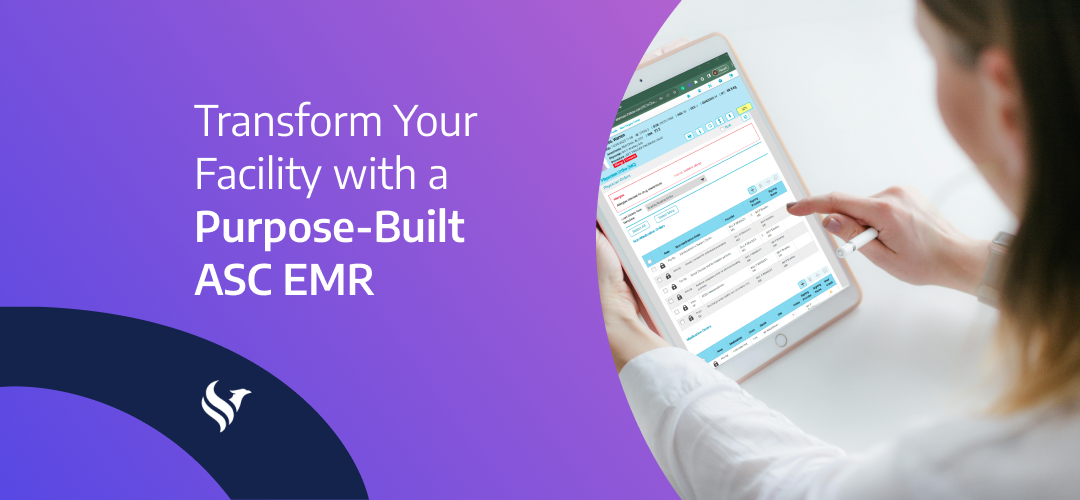
Imagine performing surgery with the wrong tools. It’s beyond ideal. That’s what it can feel like when ASCs rely on EMRs designed primarily for physician practices or inpatient hospitals, where workflows and documentation priorities differ from outpatient surgery. They’re clunky and not quite right. We understand. You deserve better. Something faster, more straightforward, and user-friendly. You need an EMR designed for the ASC environment.
Selecting an EMR for your ASC is an operational decision that affects patient flow, documentation quality, staff workload, and billing speed. An ASC moves through pre-op, intra-op, PACU, and discharge on a tight cadence, and the chart needs to keep up with that pace while supporting compliance and audit readiness. Purpose-built charting tools for the ASC environment focus on fast navigation, clear status visibility, and workflows that match real perioperative work.
EMR Selection Checklist for ASC Leadership Teams
A purpose-built ambulatory surgery center’s EMR software selection process stays grounded when it checks the following items:
- Chart completion indicators that show open items by role
- Task routing that reduces end-of-day chart chasing
- Tablet workflows that support consents and bedside charting
- Collaboration features that support simultaneous documentation
- Reporting that matches compliance logs and operational review needs
- Permissions and audit logs that support traceability
- Integration with scheduling, billing, and supply workflows
Many ASCs evaluate these items through a short pilot or workflow demonstration using real case types and real roles. That approach helps validate whether ASC EMR systems align with the center’s day-to-day workflow and charting requirements.
The Benefits of Implementing an EMR into Your ASC
ASCs aren’t just another healthcare setting. They have their own rhythm. Their own specific set of needs. ASCs move fast. They need charting systems that keep up with them. These are some of the benefits of an ASC EMR.
Improve Your Center’s Efficiency
A dedicated ambulatory surgery center EMR supports that rhythm with perioperative screens that surface the right fields at the right time, along with quick access to schedule details and patient identifiers to reduce charting friction. ASC EMRs are built for speed and efficiency, and the best ones are designed with direct input from clinicians and ASC operators who understand perioperative workflows. Hospital and physician practice EMRs are often optimized for different care settings and can require significant customization to support ASC workflows efficiently.
Think about it this way. You wouldn’t wear flip-flops to run a marathon, right? Just like specific footwear is essential for certain activities, ASC-specific software is crucial for optimizing efficiency and patient care within the ASC environment. Digital charting software for hospitals or physician practices might suffice for basic tasks. But when you’re navigating the complexities of surgery centers, you need something more tailored. You need ASC EMR software. It’s like swapping those flip-flops for running shoes designed for peak performance.
Similarly, ASC EMR software improves your center’s performance. Lowering operational inefficiencies and boosting patient care through its ASC-intuitive workflows. This means faster, easier charting for your clinicians.
ASC-focused charting often includes:
- Tablet-optimized documentation for point-of-care charting in pre-op, the OR, and PACU
- Visual status indicators that show what is complete and what still needs attention
- Task routing that assigns missing items to the right role so charts close reliably
Complete All Your Charts, Every Time
Ever experienced incomplete charts? It’s more than a hassle. It poses a risk of errors and delays in care. A solid ASC EMR should help ensure every chart is complete. It needs to provide a summary of how complete a chart is, so it’s clear when there is still work to be done. Also, it should seamlessly help your center further overcome incomplete charts with built-in task management.
A charting system that supports consistent closure typically provides:
- A completion view that shows chart progress by workflow section
- Built-in task assignments that route missing elements to the correct clinician
- Alerts for missing documentation elements that commonly stall chart finalization
Modern ASC EMR systems should leverage automated workflows triggered by predetermined criteria so all clinicians can easily see their assigned tasks and be directed straight to empty fields. With complete charting, you can streamline your center’s operations, reduce risks, and ensure top patient care. Imagine if chart completion were predictable and consistently near completion at day’s end, with clear visibility into what still needs attention. Every time, no gaps, no guesswork. That’s the kind of efficiency and peace of mind an ASC EMR can and should bring.
Direct E-signature Capabilities
Ever found yourself being bogged down by physical documents? Or linking up a signature pad to your current EMR software to get a patient’s consent? It feels outdated. It’s like sending a fax in today’s digital world.
A robust ASC EMR should support e-signature workflows for patients signing directly on a tablet, while also accommodating paper or hybrid workflows where required. It’s about making your life easier, reducing errors, streamlining consents, and improving operational workflows.
Intuitive UI & More Mobile Charting
A user-friendly platform is essential for a busy ASC staff. It’s not just a luxury. It’s a necessity. With a clean, intuitive interface, you’ll experience quicker training, fewer clicks, and faster documentation.
Also, your staff should be documenting on tablets. It offers more freedom. You’re not tied to a desktop or one location. With an ASC-specific EMR optimized for tablets, this can be your reality. You’ll notice fewer clicks. And you’ll streamline your staff’s charting, making their day-to-day smoother.
For even greater mobility, authorized users should be able to access the EMR remotely through secure, role-based access controls. With cloud-based software, your team can collaborate seamlessly and manage patient care anywhere with an online connection.
Mobility features that matter in real workflows include:
- Tablet-friendly screens for pre-op and PACU documentation
- Secure remote access that supports timely signatures and chart close-out
- Flexible device options across laptops, tablets, and desktops
Seamless Collaboration
Now, imagine having an EMR where multiple clinicians can document in the patient chart simultaneously within defined sections, with visibility into concurrent activity. Your ASC EMR should show you when another clinician is there, making changes alongside you.
This kind of real-time visibility is a game-changer, effortlessly boosting collaboration. No more waiting around for updates because you’re all on the same page, seamlessly working together to provide the best care possible.
Perioperative documentation is a team effort across nursing, anesthesia, surgeons, and clinical leadership. A modern EMR for surgery center operations benefits from real-time collaboration features that reduce handoff gaps and duplicate documentation.
The Shift to Proactive Operations with an ASC EMR
The right surgery center EMR is not just a tool but a vital ally in your ASC’s success. By choosing an EMR designed with ASC-specific needs in mind, you’re not just investing in software. You’re investing in a better future for your facility. Choose a system as precise as the care you provide. It’s time for your center to start using an ASC EMR built by clinicians for clinicians, like HST’s electronic charting.
HST’s electronic charting isn’t just another EMR. HST’s electronic charting was built with ASCs’ unique needs at the forefront of its design. It embodies the precision, efficiency, and collaboration that ASCs require.
- Experience real-time care updates with insights from clinicians.
- Facilitate collaboration with HST’s electronic charting’s LiveEdit™ technology, allowing multiple users to update a patient’s chart simultaneously.
- Leverage 29 EMR-specific reports for strategic planning.
- Enjoy tablet-optimized charting for reduced clicks and enhanced staff mobility.
- Simplify consents with integrated e-signature capabilities.
- Increase your chart completion rate with the Chart Completion Summary Report & Task Manager.
- Access your charts from anywhere with cloud-based technology.
- Plus, integrate with HST’s surgery center management.
What ASC Leaders Should Evaluate Before Choosing an EMR
ASC selection teams usually evaluate charting through the lens of daily throughput, chart closure, billing readiness, and patient safety. The most useful evaluation process starts with workflow mapping. It identifies the charting moments that can slow a day down, such as pre-op phone calls for missing history, day-of-surgery H&P updates, consent collection, implant documentation, anesthesia start and stop times, and PACU discharge readiness. A strong ASC EMR makes those moments easier to manage through structured workflows and visible completion status.
Perioperative Workflows That Need to Work Without Extra Steps
A reliable perioperative workflow supports predictable charting in each area of care:
- Pre-op: history capture, allergy review, medication reconciliation, consents, and readiness checks
- Intra-op: time-out, procedure details, laterality, implants, supplies used, and operative documentation
- PACU: recovery milestones, pain and nausea documentation, discharge criteria, and post-op instructions
Chart Completion Visibility That Supports Faster Close-Out
ASC leadership often monitors open charts because they delay coding and billing and create compliance exposure during payer requests. Chart completion tools are most useful when they show:
- Completion percentage by workflow section
- Missing items by type and by owner
- A task manager that routes missing pieces to the appropriate clinician
- A clean close-out path for signatures
Collaboration That Reduces Handoff Gaps
Handoffs happen quickly in ASCs. Charting tools support safer handoffs when they allow multiple roles to document without waiting on each other. This type of collaboration supports common ASC use cases:
- Anesthesia updates during a surgeon’s documentation session
- Nursing documentation in PACU while discharge tasks are being prepared
- Clinical leadership review of completeness while staff are finishing the day
Integration Points That Reduce Double Entry
Integration is valuable when it removes double documentation and keeps the schedule, clinical record, and billing workflow aligned. Integration evaluation usually covers:
- Schedule to chart initiation
- Preference cards and supply capture
- Implant documentation and inventory linkage
- Charge capture readiness for billing workflows
Security and Auditability That Support HIPAA Expectations
ASC administrators look for controls that support privacy and audit readiness without slowing clinicians down. HIPAA Security Rule guidance emphasizes appropriate safeguards for ePHI, including access controls and audit controls. ASC leaders often look for role-based access controls, audit logging, MFA support, and a clear separation between clinical and administrative privileges.
Practical Mobility and Device Support
Tablet charting is common in pre-op and PACU because it occurs at the bedside and in motion. A practical device review for ASC EMR software selection often includes:
- Wi-Fi coverage testing in pre-op, OR corridors, PACU, and discharge areas
- Tablet workflows for consents, discharge instructions, and bedside documentation
- Downtime workflows that allow perioperative documentation and later reconciliation when systems are unavailable
Cost Clarity for Budgeting and Board Approval
Pricing for EMR systems varies with center size, number of users, modules, interfaces, implementation support, and contract terms. A practical way to answer how much an EMR system costs for ASCs is to request a vendor quote that itemizes implementation, training, interfaces, ongoing subscription fees, and any add-on reporting or analytics costs. A three-year total cost view supports a cleaner budget discussion and a clearer ROI conversation.
Discover the HST’s Electronic Charting Difference
Curious about how HST’s electronic charting can revolutionize your ASC’s operations? Check out how BASS Surgery Center was able to use HST’s electronic charting for clinical time savings and enhanced patient safety:
- An increase in chart completion, from 30% to nearly 100%
- A reduction in hospital transfer times, from 20 to 3 minutes
- 50% time savings in chart prep and staff training
More Reasons Why ASCs Love HST’s Electronic Charting
“We have 0 open charts and 100% closure, which translates into profitability. When those things happen, it gets bills out quickly, it reduces AR, and it helps the whole process move along to completion of the patient encounter.” Jimmy Norman, Administrator at EAMC Lanier
“You have the absolute most user-friendly EHR I’ve ever used. I love it so much, I want to be able to use HST in my inpatient hospital as well!” Tawna Zauner, PSN Affiliates – Multiple Centers
Click here to explore more of what sets HST’s electronic charting apart for surgery centers. Discover how the right ASC EMR can elevate care, efficiency, and satisfaction across your facility.
Don’t miss out on the good stuff – Subscribe to HST’s Blog & Podcast!
Every month we’ll email you our newest podcast episodes and articles. No fluff – just helpful content delivered right to your inbox.